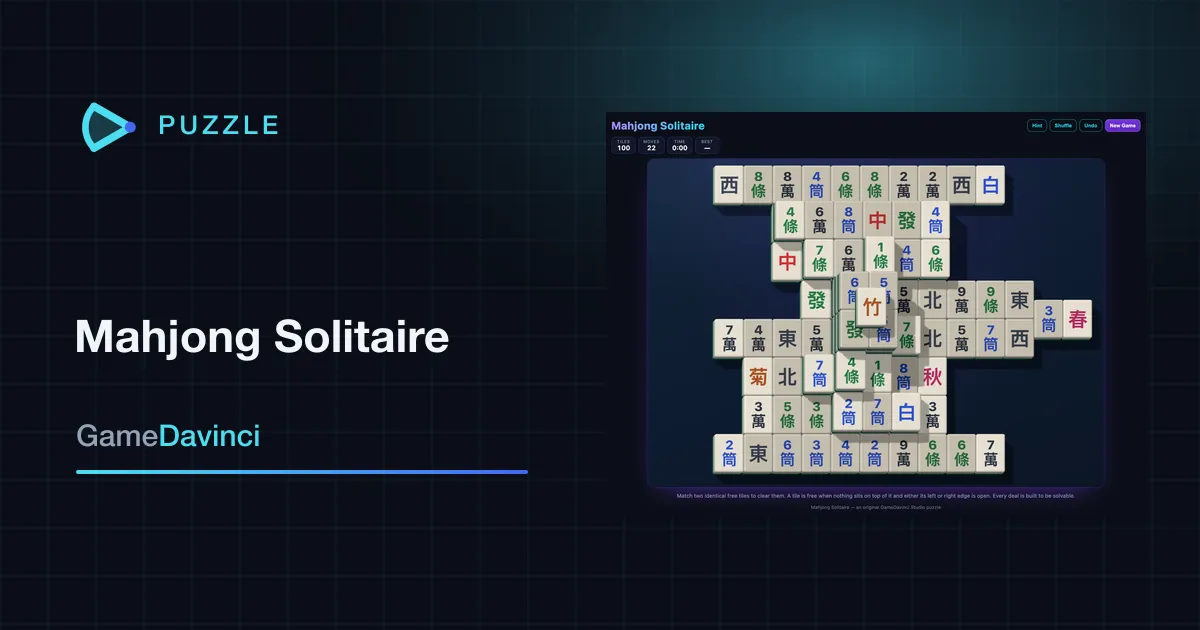

"Is every Mahjong Solitaire game winnable?" gets asked constantly, and it has two honest answers depending on which game you mean.
A deal shuffled at random can be dead before you make a move. Nothing about a random shuffle promises that the tiles you need will ever be free at the same time. That is simply what a shuffle is.
Every deal in our Mahjong Solitaire can be cleared, because we do not shuffle. We build the board backwards: tiles are placed in pairs onto slots that are free at the moment they are placed, so undoing the construction is, by definition, a winning line. We do not take the generator's word for it — replaying that line on 50 deals cleared all 144 tiles 50 times out of 50.
That sounds like the end of the story. It is the start of it.
We played 1,000 guaranteed-winnable boards
We took the first 1,000 deals and played each one with a bot that does the laziest thing possible: find every legal pair, pick one at random, repeat until the board is clear or nothing is left to match. No undo, no shuffle.
| Player | Boards cleared, of 1,000 | Tiles left when stuck (median) |
|---|---|---|
| Random legal pair, run 1 | 406 | 34 |
| Random legal pair, run 2 | 406 | 34 |
| Random legal pair, run 3 | 404 | 34 |
| Take the pair that leaves the most moves open | 515 | 26 |
Every one of those 1,000 boards was winnable. Random play lost about six in ten of them anyway.
Three separate random runs landing within two boards of each other is what tells you 40% is a property of the game, not luck in the sample. A typical stuck board still had 34 of its 144 tiles on it — the game did not end early through bad luck on the last move, it ended through a choice made a long time before.
Why a winnable board goes dead
Most tile faces exist in four copies. Take the wrong two of the four and the other two can end up under a stack you can no longer reach — or on either side of the same row, both pinned. The pair you took was legal. It was also the move that lost the game, and nothing on screen tells you that when you make it.
That is why "is it winnable?" is the wrong question. The useful one is: winnable from where? A deal that can be cleared from the start can stop being clearable after one careless pair.
(A correction, because we got this wrong ourselves: an earlier post of ours, Calm Puzzles and Hard Puzzles, filed Mahjong alongside the tap-away games, where no legal move can ever make a board unsolvable. That is not true of Mahjong. The numbers above are the proof.)
One habit was worth eleven boards in a hundred
The fourth row of the table is a bot with exactly one idea: before taking a pair, look at how many matches will be available afterwards, and take the pair that leaves the most. It is a one-move lookahead and nothing more — no plan, no memory of which copies are buried.
That single habit took the clear rate from about 40% to 51.5%, and when it did get stuck it had cleared further, 26 tiles left instead of 34.
A person does better than either bot, because a person can see what these two cannot: that two copies of the same tile are stacked directly on top of each other and can only ever match each other, or that a long row releases its tiles two at a time and needs starting early. Those are in the Mahjong Solitaire rules and strategy page, and we have not measured human players, so we will not put a number on how much they add. The bots set the floor: careless play loses most winnable boards, and a little foresight wins the majority.
What this means when you lose
If you get stuck in our Mahjong Solitaire, the board was not dealt against you. There was a way through when you started. That is worth knowing, because it changes what the right response is:
- Undo before you shuffle. Undo takes you back to the decision that lost it. Shuffle gives you a different puzzle and throws away what you worked out.
- Look for all four copies before taking a pair. It is the one check that catches the stranding move before you make it.
- If you lost with 30-odd tiles left, the mistake was early. Go back further than feels necessary.
It is also why Mahjong is not quite the calm, can't-go-wrong game it looks like. It is forgiving — 40% of boards clear themselves under completely random play — but the difference between clearing and not is a decision you made, which is exactly what makes a win feel like one.
Play Mahjong Solitaire free — in the browser, no download, no account. Every deal can be cleared. Whether it gets cleared is up to you.