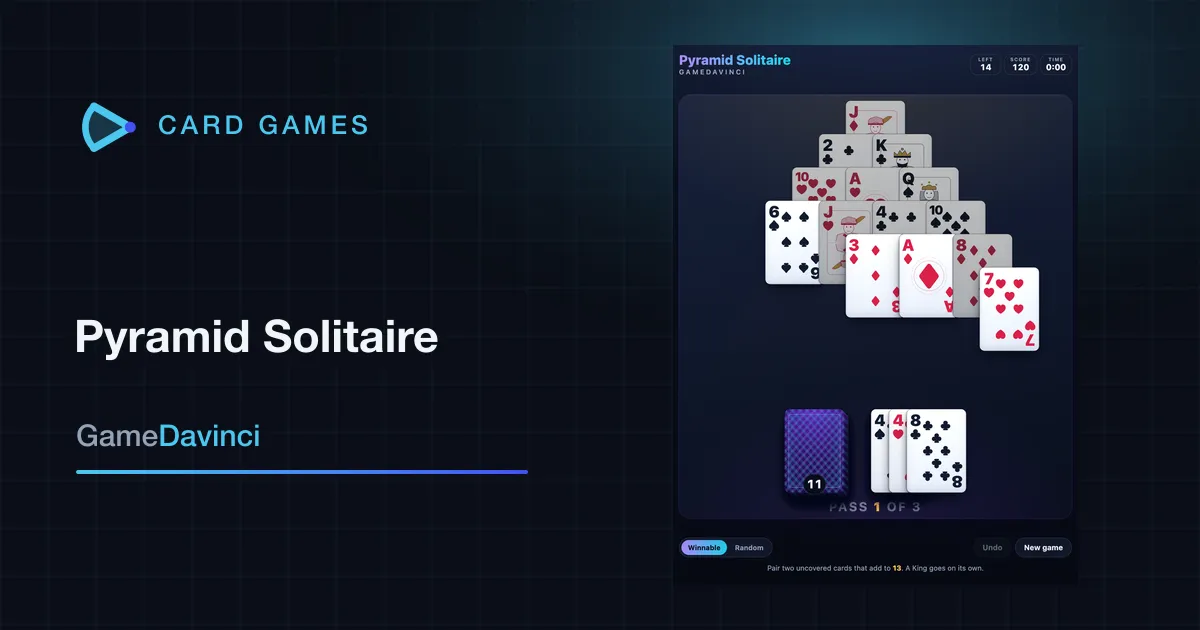

Pyramid Solitaire is quick to learn — pair two uncovered cards that add to thirteen, Kings leave alone, clear the pyramid — and it has a reputation for being mostly luck. People who play it a lot tend to say "most deals can't be won" and leave it there.
We needed an actual number, because our Pyramid Solitaire has a mode that promises every deal can be won, and a promise like that has to be checked by something that is not a person. So the game carries a solver: a search that tries every legal line from a deal until it finds a win or runs out of lines to try.
Here is what it found.
The odds, with the standard three passes
We took 200 shuffled deals and gave the solver up to five million positions per deal — far more than any game needs in practice.
| Result | Deals, of 200 | Share |
|---|---|---|
| Proven winnable | 128 | 64.0% |
| Proven impossible — every line tried, none clears the pyramid | 55 | 27.5% |
| Undecided within five million positions | 17 | 8.5% |
So the honest answer is a range: between 64% and 72.5% of Pyramid deals can be won with perfect play, and at least 27.5% cannot be won by anyone. More than one deal in four is lost before the first card is turned, and no amount of skill changes that.
Perfect play is doing a lot of work in that sentence. The solver sees the whole deck, including the face-down cards you have not reached yet. You do not. A human's real win rate on random deals is lower than 64%, and we have not measured human players, so we are not going to guess by how much.
The rule that matters most is the one people skip
Pyramid is played with different numbers of passes through the deck, and most rule sheets mention it in one line. It is the single biggest lever in the game. Measured over 300 deals with the solver:
| Passes through the deck | Deals proven winnable |
|---|---|
| One pass (no redeal) | 4.0% |
| Two passes | 45.7% |
| Three passes | 61% |
These are shares the solver could prove inside the game's everyday search budget, which is why three passes reads 61% here and 64% in the bigger run above: given more room, the solver proves a few more. The shape does not change.
One pass is the authentic, old-school rule, and it is brutal: fewer than one deal in twenty can be won at all.
If you have been playing a one-pass version and losing almost every game, that is not you. That is the rule. Going from one pass to two multiplies the winnable deals more than tenfold. We ship with three passes, which is the count that leaves most deals worth thinking about.
Why so many deals are dead
Thirteen is fixed, so every card has exactly one partner rank. A two needs a Jack. There are four Jacks in the deck. If the Jacks you need are buried under the very twos they are supposed to free — or spent early on twos from the waste pile — the pyramid locks, and it locks in a way you can often see coming only after it has happened.
Kings are the exception: they leave alone, so a deal with its Kings in the bottom rows, where they come free early, is a friendlier deal. That kind of structural luck is most of what "Pyramid is luck" actually means. The rules and strategy page goes through the counting you can do before you start to tell a hopeful deal from a hopeless one.
Why our default is "Winnable"
Losing a deal that nobody could have won teaches you nothing, and it is the fastest way to decide a game is not worth your time. So our Pyramid Solitaire opens in Winnable mode: before it hands you a deal, it runs the solver and only gives you one the solver has proved has a solution.
We checked the promise rather than trusting it. Over 200 new Winnable deals, the solver proved a solution for all 200, and re-solving 20 of them from scratch found a full solution every time. If the game ever cannot prove a deal in time, it says so on screen instead of claiming a guarantee it does not have.
That changes what a loss means. In Winnable mode, if you lose, there was a way through, and undo will help you find it. In Random mode you get the deal unfiltered — the traditional game, where more than one deal in four is already over.
Both are worth playing. They are just different games, and it helps to know which one you are in.
Play Pyramid Solitaire free — in the browser, no download, no account.
If you like knowing the odds before you start, the same kind of solver sits behind Golf Solitaire, where one rule — whether a King can go on an Ace — moves the clearable deals from 45.8% to 92.8%. And if you would rather have a deal that is always winnable and still has to be earned, every Mahjong Solitaire deal can be cleared — random play still loses most of them.