How to play Chess Puzzles
A new forced mate every day. Find the win in one, two or three moves — wrong moves are refused, so you have to actually see it.
One chess puzzle a day with the same instruction every time: White to play, and there is a forced mate. Find it.
What "forced" means
Forced means it works against every legal defence. Not the most likely defence, not the natural-looking one — every single one.
That distinction is the whole of tactical chess. A move that mates only if Black cooperates is not a solution, and this is exactly where beginners go wrong: they find a line that ends in checkmate, assume it, and never check what happens if Black interposes a piece or gives up material to delay.
The pill at the top of the board tells you the length of the mate. Mate in two means two White moves including the first; mate in three means three.
How the board responds
Play the move on the board and it tells you immediately whether you were right.
A move that lets Black wriggle out is refused with a reason rather than quietly accepted. That is deliberate: a tactic you can shuffle your way through teaches nothing, and a position that drifts away from the solution after a wrong move is a position you can no longer solve.
Get the key move right and Black replies with its most stubborn defence — not a random legal move, the hardest one — and you carry on until mate.
Every legal defence has an answer. If a reply surprises you, the puzzle is not broken; look again.
Every puzzle is proved
The position is composed, then an exhaustive mate search — not an engine evaluation, an actual search over every legal continuation — confirms both that the mate exists and that it is unique.
Uniqueness matters as much as existence. A puzzle with two different first moves that both mate has no single answer to find, and finding one of them teaches you nothing about why it was right.
How to look for a mate
Start with checks, not with good moves. In a mating puzzle the solution is almost always a check or a move creating an unstoppable threat, and there are far fewer checks available than legal moves.
Count the escape squares. Look at the enemy king and list the squares it can move to. A mate has to cover all of them plus the square the king is on, so a move that covers three of four escape squares is probably not it, and a move that takes away the last flight square usually is.
Look for the sacrifice. In composed problems the key move very often gives something away — it removes a defender, deflects a piece, or opens a line — and it looks wrong precisely because it loses material. If the natural moves do not work, ask which piece is defending the mating square and what would happen if it were not there.
Work backwards from the mating picture. Ask what position would be checkmate, then ask how to get there.
Hints and modes in the puzzle trainer
Two hints are available: the first names the piece to move, the second where it goes. Solve the daily to keep a streak, or switch to Practice for unlimited puzzles at a chosen difficulty.
Controls
Tap a piece then a highlighted square, or drag it.
Keyboard
- Arrow keys move the cursor, Enter picks up and places, Escape cancels.
- H for a hint, R to reset the position.
Strategy tips
- Look at every check first. The key move in a mating puzzle is nearly always a check, and there are far fewer checks than legal moves.
- Count the king's escape squares before you calculate. A mate must cover all of them, so any candidate that leaves one open is not the answer.
- Suspect the move that loses material. Composed mates usually begin with a sacrifice that removes a defender or opens a line — that is why it is hard to see.
- Ask what is guarding the mating square. If one piece is holding the position together, the solution is often the move that removes, deflects or blocks it.
- Check every legal defence, not the natural one. A line that mates against the obvious reply and fails against an interposition is not a solution.
- Work backwards from the picture. Imagine the position that would be checkmate, then work out the moves that reach it.
- Use the move count as information. Mate in two means there is no time for a quiet build-up, so the first move must already be forcing.
- Take the first hint before the second. Knowing which piece moves usually gives the whole idea away, and finding the square yourself is where the learning is.
Now play Chess Puzzles
Free, in your browser, with no download and no sign-up.
Play Chess Puzzles →Chess Puzzles is a board game . See all board games or browse the whole catalogue .
More rules and guides
-
 Featured
Connect Four
Drop your discs and be the first to line up four in a row against a computer that actually plans ahead.
Board -
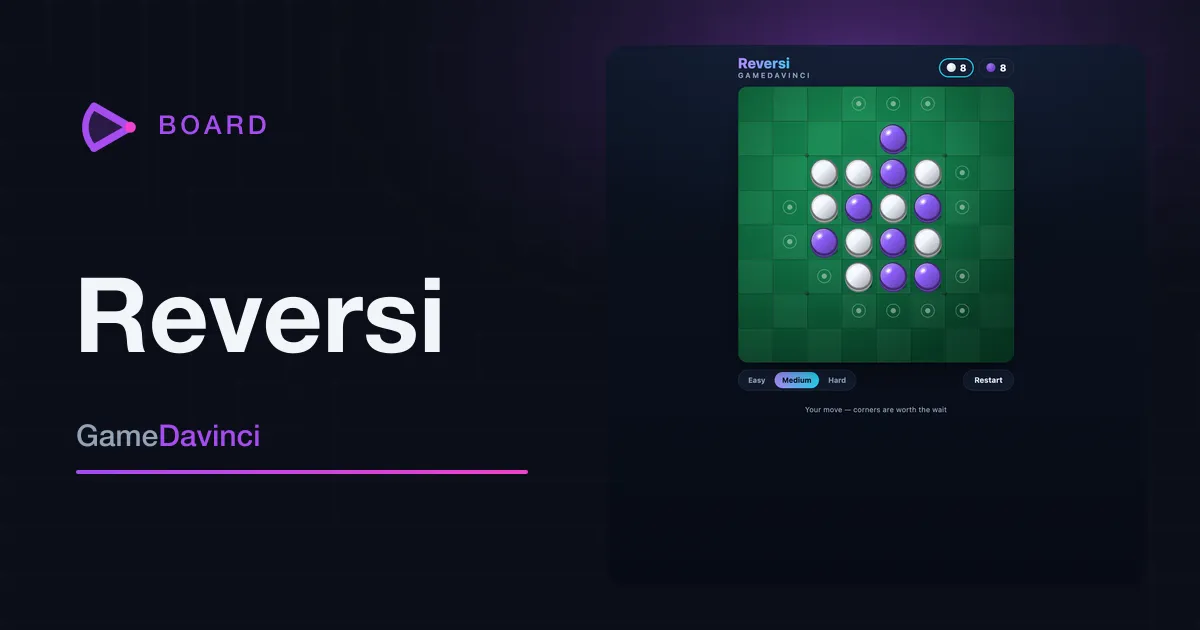
Reversi
Outflank the computer to flip its discs to your colour and own the most of the board when it fills.
Board -

Checkers
Jump and crown your way to victory in classic draughts against a computer that hunts for every capture.
Board -
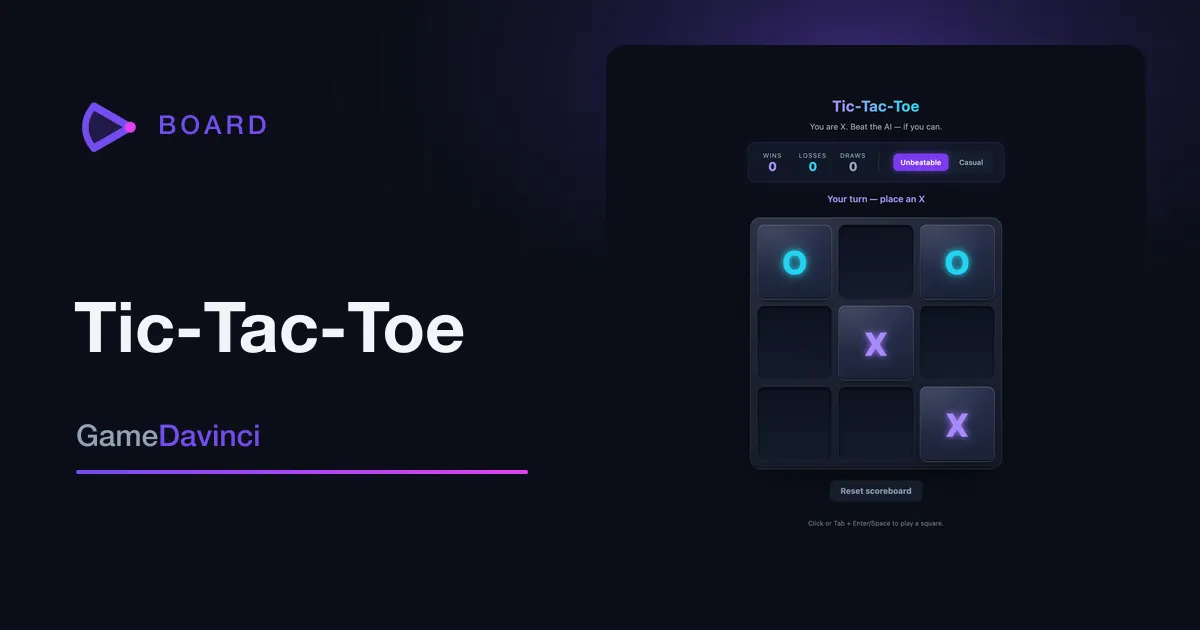
Tic-Tac-Toe
The timeless 3-in-a-row duel — take on an AI that never loses, or dial it back to casual.
Board