How to play Gomoku
Place stones on a 15x15 board and be the first to line up five in a row, against a computer that reads your threats.
Gomoku is five in a row on a fifteen-by-fifteen board. Both players know all the rules before the first move, which is why it is such a good game: nothing is hidden behind a rulebook, and everything is hidden in plain sight on the board.
The move
Stones are placed on the intersections of the grid, not in the squares. You play teal and move first; the computer plays magenta. Take turns placing one stone on any empty intersection. Stones never move once placed, and are never captured or removed.
Winning a game of Gomoku
The first player to make five of their own stones in an unbroken line wins — horizontally, vertically, or along either diagonal.
This is free-style Gomoku. There are no forbidden opening shapes, no restrictions on the first player, and an overline of six or more in a row counts as a win rather than being disallowed. That matters because in some tournament rulesets an overline is explicitly not a win for the first player, and beginners who learned those rules expect a different result here.
The one shape that decides the game
Everything in Gomoku follows from the open three: three of your stones in a row with an empty, playable point at each end.
Left alone for one move, an open three becomes an open four — four in a row with an empty point at both ends. An open four cannot be blocked. There are two points that complete it, your opponent has one move, so the game is already over.
This gives the whole game its rhythm. An open three must be answered immediately, every time, or you have lost. Everything else is negotiable; that is not.
A closed three — three in a row with one end blocked by an enemy stone or the board edge — is far less dangerous, because completing it makes a four with only one open end, which your opponent simply blocks. Learning to tell an open three from a closed one at a glance is most of the skill of the game.
Double threats
Since a single open three can always be answered, strong play means making two threats with one stone. The classic is the double three: a stone that completes two separate open threes at once. Your opponent can block one, and the other becomes an open four.
A four-and-three — one stone creating both a four and an open three — is even stronger, because the four must be blocked immediately, which gives you a free move to convert the three.
Almost every game between players who know what they are doing is a race to build a double threat while stopping the other person's.
Defence
Blocking is not passive. The best block is the one that also builds something of your own, so before you answer a three, check whether one of the two blocking points also extends a line you already have. A block that develops is worth two moves.
Watch for shapes that are not literally in a row: a "broken three" with a gap in it — stone, stone, gap, stone — is one move from a four and beginners routinely ignore it.
The opponent
The computer scores every possible five-in-a-row window on the board, so an open shape naturally counts for more than a blocked one, and it searches ahead with alpha-beta pruning and a transposition table. Easy looks barely a move ahead and will miss a plan. Medium punishes a loose three. Hard defends while building threats of its own.
Controls
Tap or click an intersection to place a stone.
Keyboard
- Arrow keys move the cursor, Enter or Space places.
- Undo takes back your last move.
Strategy tips
- Answer every open three immediately. Three stones with both ends free become a four that cannot be blocked, so there is never a more urgent move on the board.
- Learn to tell an open three from a closed one instantly. A three with an enemy stone or the board edge at one end is not the same threat, and treating it as one wastes the move that loses the game.
- Look for the broken three — stone, stone, gap, stone. It is one move from a four and it does not look like a threat, which is exactly why it works.
- Aim for the double three: a single stone that creates two open threes at once. Your opponent can block one of them, and that is the game.
- The four-and-three is stronger still. A four must be answered, so the three it comes with gets a free move to become an open four.
- Block with a stone that also builds. Of the two ends of a three, one usually extends a line of your own — take that one and you have defended and attacked in a single move.
- Play near the centre in the opening. Lines through the middle have room to extend in both directions; lines near the edge die against it.
- Count before you commit to a race. If you are both one move from winning, the player to move wins, so check whose turn it actually is before starting a sprint you will lose by one tempo.
Now play Gomoku
Free, in your browser, with no download and no sign-up.
Play Gomoku →Gomoku is a board game and a longstanding classic. See all board games or browse the whole catalogue .
More rules and guides
-
 Featured
Connect Four
Drop your discs and be the first to line up four in a row against a computer that actually plans ahead.
Board -
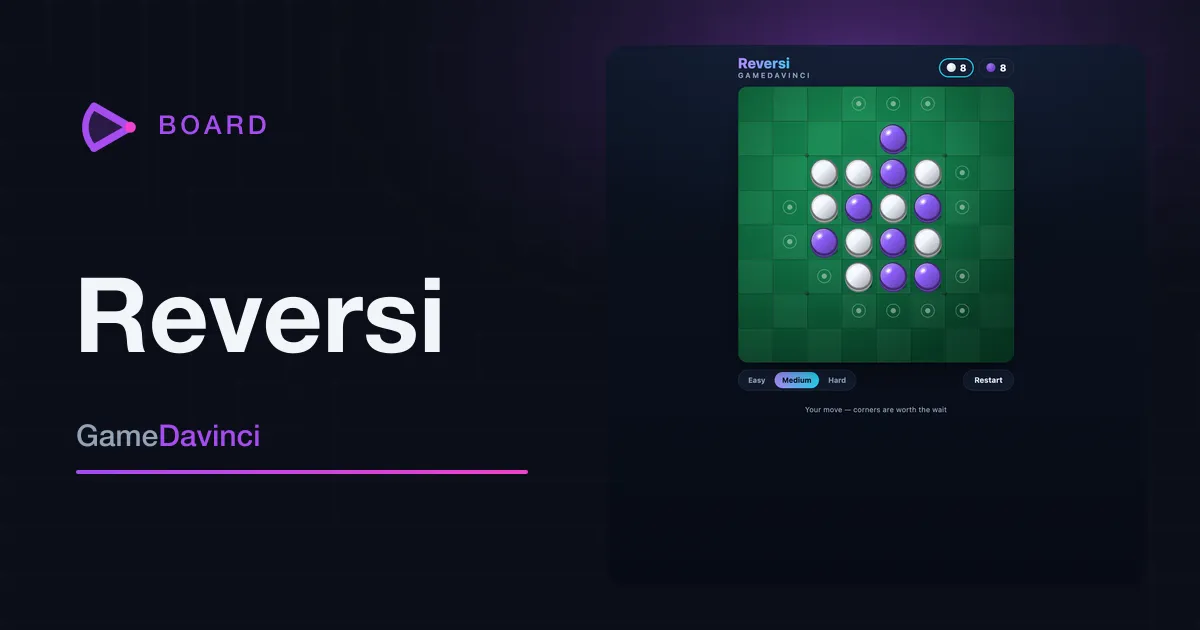
Reversi
Outflank the computer to flip its discs to your colour and own the most of the board when it fills.
Board -
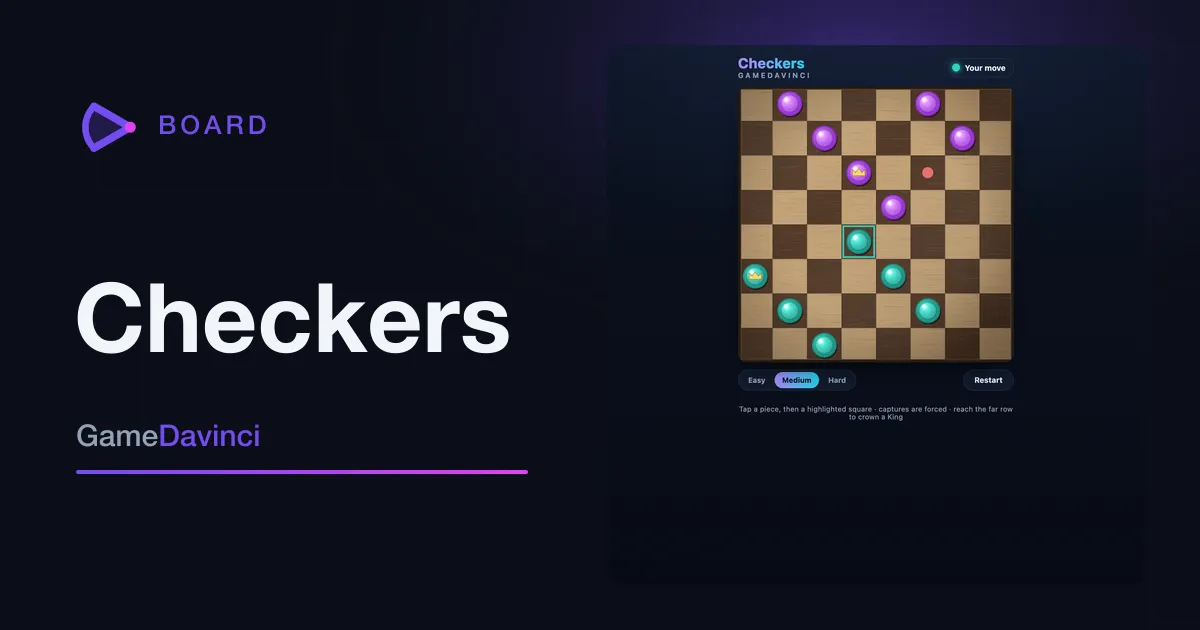
Checkers
Jump and crown your way to victory in classic draughts against a computer that hunts for every capture.
Board -
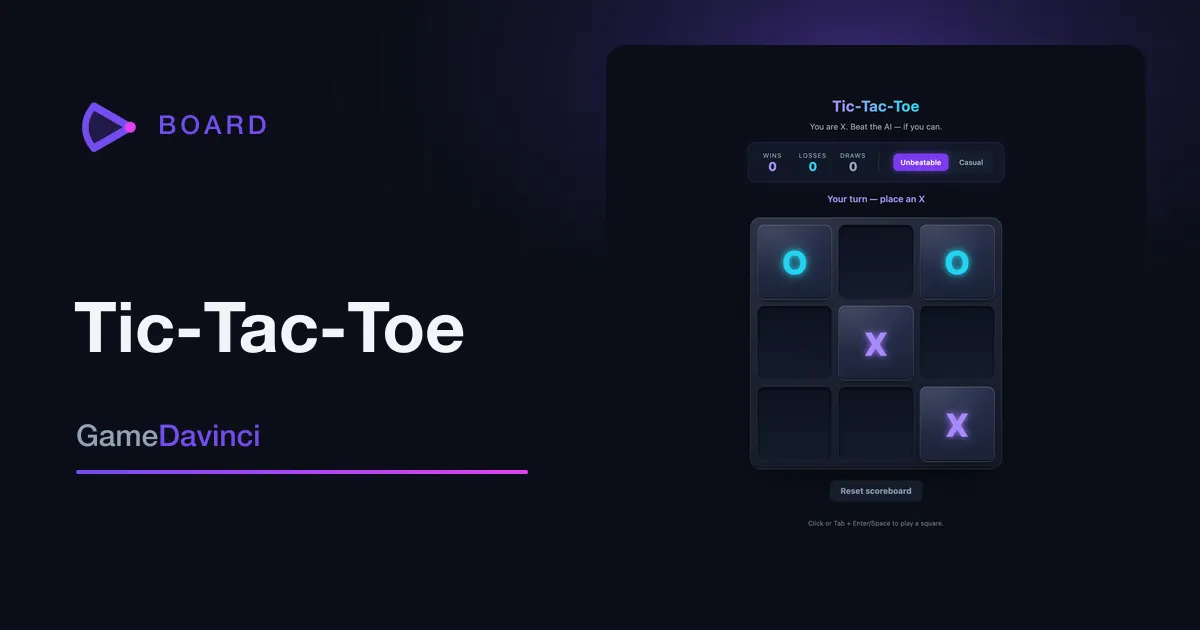
Tic-Tac-Toe
The timeless 3-in-a-row duel — take on an AI that never loses, or dial it back to casual.
Board