How to play Stack
Time your tap to drop each moving block dead-centre and build the tallest tower you can before it slips away.
Stack is a one-tap tower game. A block slides back and forth above your tower and you tap to drop it.
The rules
Drop a block and any part of it that overhangs the block below is sliced off. The remainder becomes the new top of the tower, and the next block is that width.
Drop a block perfectly centred and you keep your full width. Chain perfect drops and the block grows back a little.
Miss the tower entirely and the run is over.
Every block adds to your height, and the pace quickens as you climb.
Why this is a game about width, not height
The height is the score, but the width is your life.
Every imperfect drop makes the next drop harder, permanently. There is no way to recover width except by chaining perfect drops, so a run does not end because you made one bad tap — it ends because twenty slightly-off taps left you aiming at a sliver.
This changes what you should optimise. It is not "land the block", it is "land the block without losing width", and those are different goals that recommend different timing.
The timing
The block moves at a constant speed and reverses at the ends. It is at its slowest, visually, at the moment it changes direction — but that is at the edges, which is exactly where you do not want to drop.
So you are timing a fast-moving object at the centre of its travel. The reliable method is not to watch the block and react; it is to find the rhythm and tap on the beat. The block's traverse is a metronome, and once you lock onto it you can tap without really looking.
That is also why hurrying is fatal. A steady rhythm is a rhythm you can predict; a panicked one is not.
Chaining perfects
Perfect drops grow the block back. This is the only recovery mechanic in the game, and it means a narrow tower is not necessarily a lost one — a run of three or four perfects can restore enough width to keep going.
The trap is that a narrow block makes a perfect harder, so recovery gets less likely the more you need it. Which is really an argument for protecting your width from the start rather than planning to rebuild it.
Speed
The pace rises with height, so the rhythm you locked onto at level ten is wrong by level thirty. Expect to re-find it, and expect the re-finding to be where most runs end.
Controls
Tap, click, or press Space (or Down) to drop the moving block. That's the only control — timing is everything.
Strategy tips
- Play for width, not height. Height is the score, but every sliver you lose makes the rest of the run harder and there is almost no way back.
- Find the rhythm and tap on the beat. The block moves at a constant speed, so timing it as a metronome is far more reliable than watching and reacting.
- Do not aim at the edges. The block looks slowest as it turns around, and that is precisely where a drop costs you the most width.
- Chain perfects deliberately when you are narrow. It is the only mechanic that gives width back, and three or four in a row can save a run.
- Re-find the rhythm after each speed-up. The tempo you locked onto ten levels ago is wrong now, and that is where most runs end.
- Slow your hands, not the game. Hurried taps scatter around the beat; deliberate ones land on it.
- Accept a small overhang rather than lunging for a perfect. A tiny slice is survivable; a miss is not.
- Treat the first ten blocks as the important ones. Width lost early is width you spend the whole run missing.
Now play Stack
Free, in your browser, with no download and no sign-up.
Play Stack →Stack is a arcade game . See all arcade games or browse the whole catalogue .
More rules and guides
-
 Featured
Neon Snake
Guide the glowing snake, gobble orbs, and grow as long as you can without crashing.
Arcade -
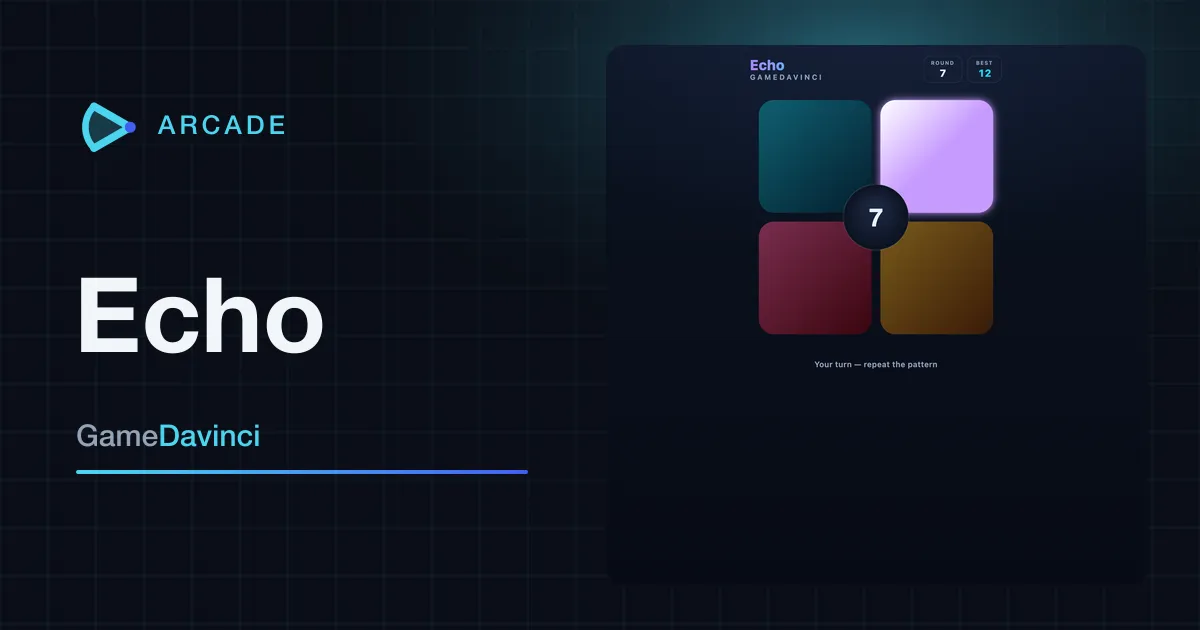
Echo
Watch the pattern of light and sound, then repeat it back — one step longer every round.
Arcade -

Rally
The original bat-and-ball duel — slide your paddle, angle your returns, and beat the computer to seven.
Arcade -
 Featured
Bubble Shooter
Aim, bank shots off the walls and burst clusters of three or more. Climb a ladder of levels for stars, or chase a score against a descending wall.
Arcade