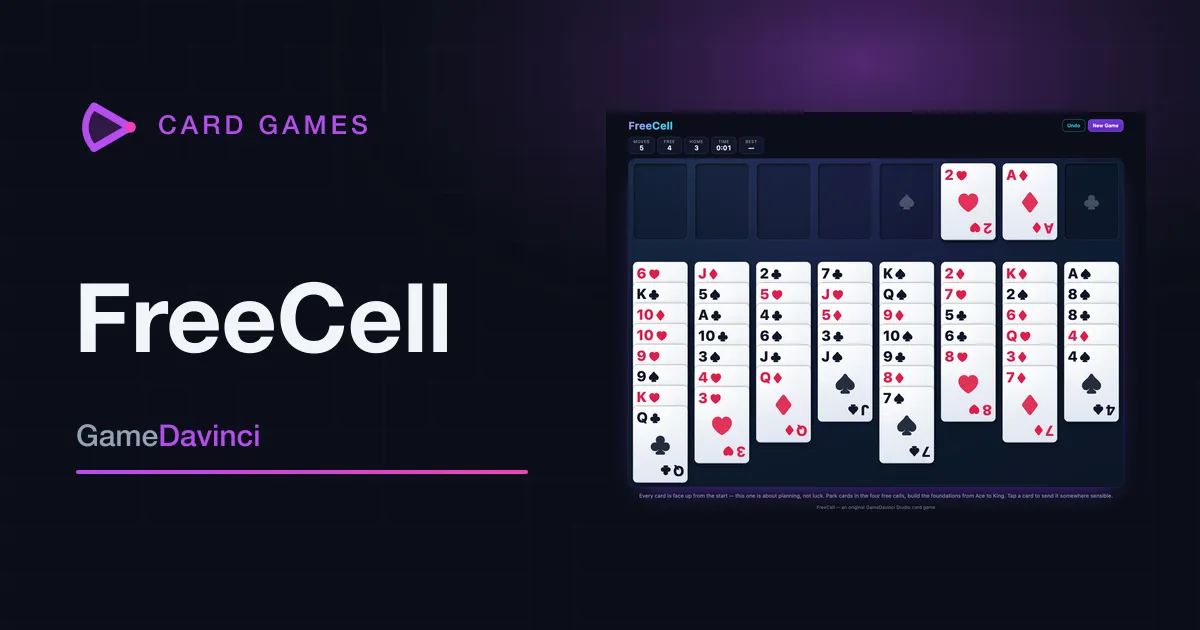

FreeCell has a reputation that no other solitaire has: almost every deal can be won. Klondike hides cards face down and makes you draw from a stock, so some deals are lost before you start. FreeCell shows you all fifty-two cards from the first second. If you lose, the usual line goes, you lost to yourself.
We wanted to check that on our FreeCell rather than repeat it, so we dealt games through the game's own shuffle and gave every one to a solver: a program that searches through possible moves until it reaches a win or runs out of the search room we allowed it.
The short answer: all 3,000 we tried
We dealt 3,000 games and the solver won all 3,000.
We did not take its word for it. Each solution was played back inside the real game, one move at a time, through the same move check that decides whether a drag you make is allowed: run lengths, the free-cell limit on how many cards can move together, and the suit printed on each foundation. All 3,000 ended with the game itself declaring the deal won. As a check on the check, we deleted one move from 20 of those solutions and replayed them again; the game refused all 20, so a broken solution cannot slip through.
Most deals were not hard for it, either:
- Half of the deals were solved after the solver had looked at 135 positions or fewer.
- 2,962 of the 3,000 were solved on the first attempt, with room for 50,000 positions.
- The other 38 needed a second, third or fourth attempt with a different way of judging positions and more room. Two needed the largest, 500,000.
That is "harder for a computer search", which is not quite the same as harder for you. We have not measured human players, so we will not guess at a human win rate. What the search does show is that the deal itself is very rarely the obstacle.
So are there unwinnable FreeCell deals?
Yes, but they are very rare, and we did not find one.
The best-known count is not ours. The original Windows FreeCell numbered its deals from 1 to 32,000, and players and programmers who worked through all of them found exactly one that cannot be won: deal #11982. Our deals are not numbered that way. The game shuffles a fresh deal each time you press New Game, so there is no "deal #11982" here to avoid.
What we can honestly say about ours: in 3,000 shuffled deals, not one beat the solver. That does not prove no unwinnable deal exists in our game; a sample that size could miss something rarer than one in a few thousand. It does mean that the deal you are looking at right now is almost certainly winnable.
The number that matters: free cells
Winnability is not really what decides your games. Space is. So we ran a second test: the same solver, the first 1,000 deals, but with some of the free cells locked away for the whole game.
| Free cells you can use | Deals the solver won, of 1,000 |
|---|---|
| 4 (the normal game) | 1,000 (in the 3,000 run above) |
| 3 | 985 (98.5%) |
| 2 | 760 (76.0%) |
| 1 | 182 (18.2%) |
| 0 | 5 (0.5%) |
Every one of those wins was replayed in the game too, with a check after each move that the locked cells stayed empty.
Read the table as a player. Losing one cell barely matters: 98.5% of deals still solve. Losing a second is a cliff: about a quarter of the deals stop solving. Down to one cell, fewer than one deal in five does.
A few honest limits. "Not solved" in that table is not the same as "impossible". For most of the two-cell failures (217 of 240) the solver did search every position it could reach and found no win, but it never takes a card back off a foundation, which our game allows, so we are not calling those deals proven dead. And we locked the cells for the entire game, which is harsher than what happens when you park a card. The direction is still the lesson.
What to do differently
Count your free cells as your margin. A card that sits in a cell for most of the game is, in effect, taking that cell out of play. One cell gone costs you almost nothing. Two gone, held for the long haul, is the zone where a quarter of deals stopped solving. If two of your cells are holding cards with nowhere to go, that is the moment to stop and undo, not to fill the third.
When you lose, replay; do not redeal. In our sample the deal was winnable every time. A lost game is a route problem, so undo back to the last point where you had a real choice and try the other branch. The rules and strategy page covers how to plan an unstack before you start it.
Expect a slow one now and then. About one deal in twenty needed far more searching than the rest: 150 of the 3,000 took over 10,000 positions. If a deal feels stubborn, it may simply be one of those. It is still very likely winnable.
Do not judge yourself by the move count. The solver's wins took a median of 97 moves, including the cards sent home automatically. It is not trying to be efficient, so that is not a target to beat, but a hundred-move game is normal.
Why FreeCell is different from other solitaires
In Pyramid Solitaire, a solver proved more than a quarter of deals cannot be won by anyone. In FreeCell we could not find a single one in 3,000. The difference is the information: FreeCell gives you all of it, and four places to think with. Spend those four places carefully and the deal is nearly always yours.
Play FreeCell free — in your browser, no download, no account.