How to play Summit Rider
Uphill physics driving over hills that are generated fresh every run: work the throttle so the nose stays down, set your attitude in the air, and go as far as the tank lets you.
Summit Rider looks like a game about hills and is really a game about one number: how much throttle the front wheel will tolerate. Everything below follows from that.
Why the front wheel lifts
The engine drives both wheels, and the force it makes acts where the tyres meet the ground — about a metre below the machine's centre of mass. A force applied below the centre of mass does two things at once: it pushes the machine forward, and it rotates it backwards. What stops the machine standing straight up is weight transfer, as load moves off the front wheel and onto the rear, but that only holds while there is load left on the front to move.
The machine is deliberately built so that full power very slightly exceeds what weight transfer can resist. On level ground the front stays down. Add a slope, and the same throttle that was fine on the flat starts lifting it. That is the skill: not steering, not braking, but reading how much power the ground in front of you will accept.
Once the front wheel is off the ground the drivetrain sends its whole torque to the rear, so the lift accelerates rather than settling. There is no equilibrium to ride. A wheelie is either coming back down because you eased off, or it is going all the way over.
The two states, and how the pedals change between them
On the ground the right pedal is drive and the left is braking, becoming reverse below walking pace. In the air both stop being propulsion entirely and become rotation: throttle pitches the nose up, brake pitches it down.
That swap is the reason jumps are survivable. Going over a crest, the machine follows the shape of the ground and leaves it already rotating nose-down at around three radians a second. Left alone it lands nose-first. The air pedals exist to cancel that and then aim the body, and they have about two thirds of a second of a typical jump to do it in — enough to choose an attitude, not enough to dawdle.
What actually ends a run
Two things, and they behave differently.
A roll is instant. The run ends the moment the roll cage — the frame over the cockpit — touches the ground. Landing at any angle short of that is fine, including a full rotation in the air that comes all the way round; a completed flip pays a bonus rather than a penalty. What kills you is arriving on the cage, which in practice means landing steeply nose-down or looping backwards off a climb.
Running dry is not instant. The engine simply stops, and the run ends once the machine has come to rest, which means a jump you were already committed to still finishes.
How the route is built, and what it promises
The ground is generated from a seed as you reach it, so the same seed always produces the same route and a stretch of hillside is identical however you approach it. Hill heights are a random walk with a hard cap on how far one point may sit from the last, which puts a ceiling on the steepest sustained gradient the route can contain — and that ceiling is below what the machine can climb. There is no unclimbable hill.
Ramps are a separate layer with their own rules. One is only ever built on ground that is already flat, never within twenty metres of another, and never without clear run-out beyond it to land in. That last rule exists because two ramps close together will launch you off the first directly into the ascending face of the second, which is not a jump but a wall with a run-up.
Fuel, and why it is a pace clock rather than a timer
The tank holds about seventeen seconds of full throttle, and cans are spaced along the route so that a run holding a normal pace arrives at each one with fuel to spare. A run that crawls, stalls on a climb and reverses back down does not. Fuel is not there to hurry you; it is there to make dithering cost something, in a game where the other failure state punishes impatience.
Coins and the boost
Coins arc over crests, usually a metre or two above the line you would drive if you were only thinking about staying upright. Twelve of them fill the boost meter, which fires by itself and gives a couple of seconds of substantially more power with no fuel drawn while it is lit. Because it fires on its own, the decision it creates is not when to use it — it is whether the detour to collect the coins is worth the risk of taking a crest faster or higher than you meant to.
The three routes
Foothills, Ridge and Summit differ in how steep the hills are allowed to get and how far apart the fuel cans sit. Each keeps its own best distance, because a Foothills number and a Summit number are not the same achievement and one record shared between them would quietly record only the easiest.
Controls
In the air the throttle pitches the nose up and the brake pitches it down.
Keyboard
- Right, Up, D or W for throttle.
- Left, Down, A or S to brake, which becomes reverse below a crawl.
- Enter restarts.
Touch
- The Throttle and Brake buttons under the picture, or hold the right half of the screen for throttle and the left half for brake.
Strategy tips
- Feather the throttle on every climb. The nose coming up is the warning, not the failure — ease off the moment you see it and the front comes back down.
- If a climb beats you, hold the brake to reverse back down, get a run-up, and take it with momentum instead of power.
- Off a jump, tap the throttle early. The machine leaves a crest already rotating nose-down, and cancelling that takes most of the flight.
- Aim the body at the slope you are landing on, not at the horizon. Flat onto a rising face is a crash; matched to the face is free speed.
- A rotation that has gone too far to save is worth completing — a full flip lands cleanly and pays five coins.
- Keep moving. Fuel drains with the engine, not with the clock, but crawling burns the same fuel over far less ground.
- Take the coin arcs on downhills and skip the ones over blind crests; a boost you earned by launching yourself sideways is not a boost you kept.
- Learn Foothills before Ridge. The throttle discipline is identical and the ground gives you far longer to get it wrong.
Now play Summit Rider
Free, in your browser, with no download and no sign-up.
Play Summit Rider →Summit Rider is a racing game . See all racing games or browse the whole catalogue .
More rules and guides
-
 Featured
Turbo Rush
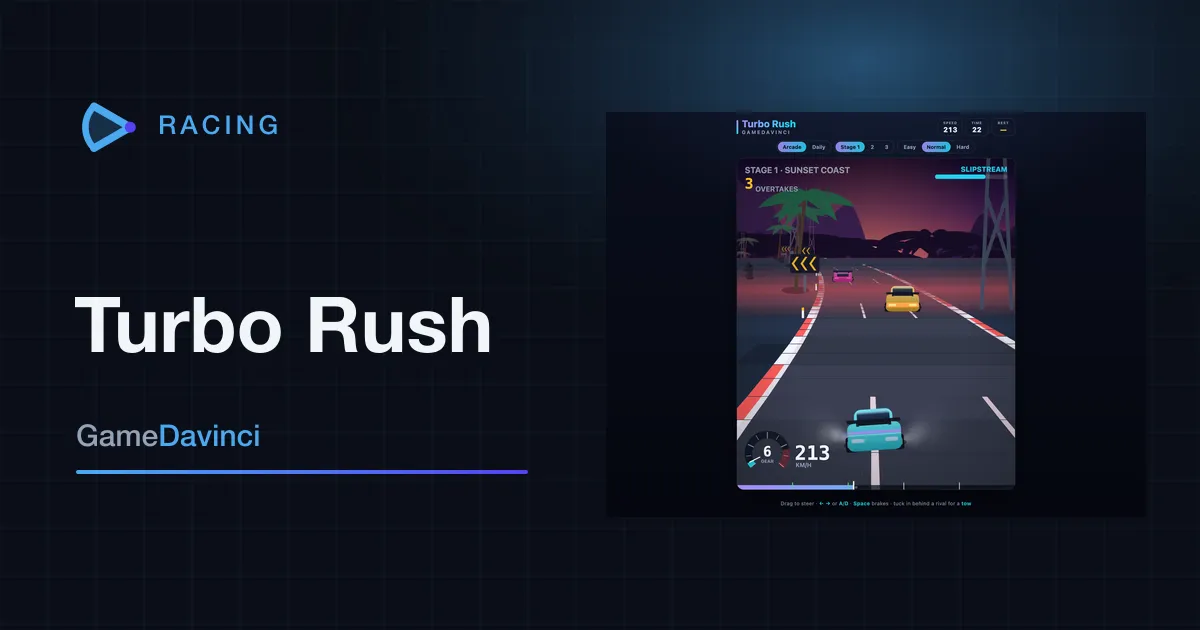
Throw a six-speed car down a pseudo-3D highway of banked corners and blind crests, slipstream past the field, clip every gate for more clock, and chase your ghost in the daily trial.
Racing -
 Featured
Drift Arena
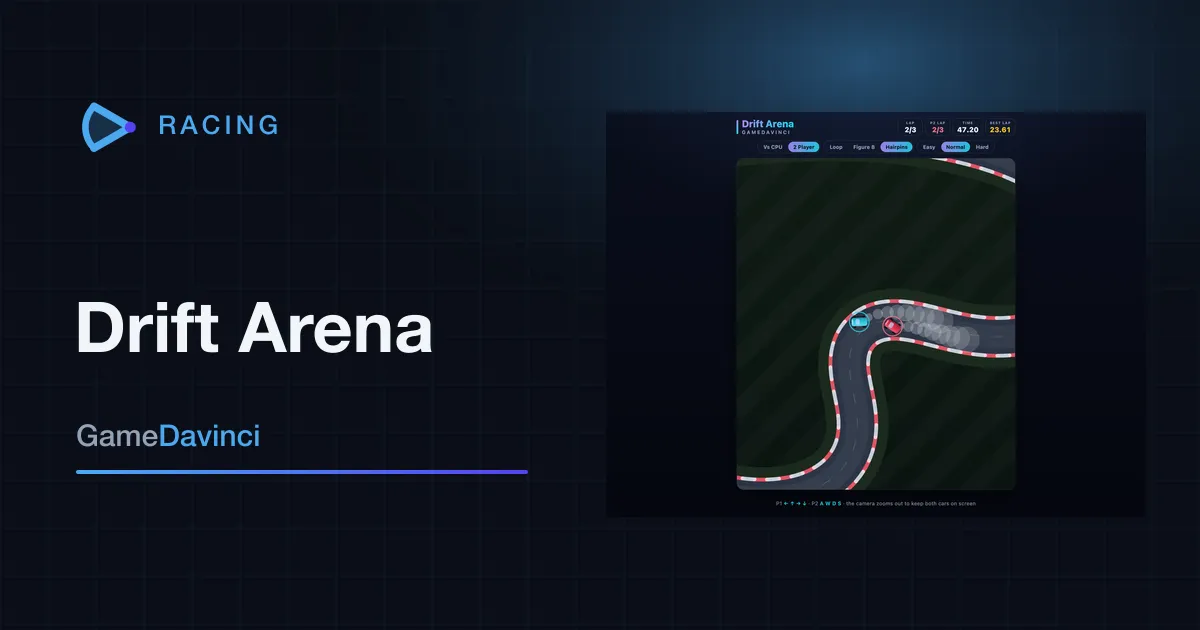
Throw a top-down racer sideways through three circuits of tightening corners, catch the slide on the way out, and settle it over three laps against the computer or a friend on the same keyboard.
Racing -

Fast Lane
Five lanes, no corners, and traffic that never quite lets up. Pick your gap early, shave past for the bonus, and see how far you get before the road wins.
Racing