How to play Fast Lane
Five lanes, no corners, and traffic that never quite lets up. Pick your gap early, shave past for the bonus, and see how far you get before the road wins.
Fast Lane is an endless traffic racer played on a five-lane motorway. Your car holds station near the bottom of the screen and the traffic comes to you. Nothing steers, nothing brakes, and there is no accelerator: the only input in the entire game is which lane you want to be in.
The road
The motorway has five lanes and no corners. Traffic arrives in rows — one row is a set of lanes occupied at the same distance — and the rows are evenly spaced. That spacing tightens as your speed rises, from forty metres at the start down to twenty-six at full speed, which is what makes the game harder over a run even though the road itself never changes.
Your speed climbs continuously from the moment you first move and stops climbing at the top of the range. It never falls. There is no way to slow down and no reason to want to, since distance is most of your score.
Changing lane
A lane change is a discrete move to the neighbouring lane and it takes a fixed time to complete. Two things follow from that, and both decide runs.
First, you cannot start a second change until the first has landed. Holding a direction does not slide you across the road; each lane is a separate commitment.
Second, you are in the lane you left until the change completes. A change begun a fraction too late has not moved you anywhere — you will be struck in the lane you were trying to leave. This is the single most common way to lose, and it is why the game rewards deciding early rather than reacting well.
Crashing
Touching any traffic ends the run immediately. There is no damage model, no second chance and no shield. The run ends, the score is recorded, and the road resets.
Scoring
Score comes from three places, and they reward different things.
Every car you get past is worth a point. A dense row is therefore worth more than a sparse one, so the traffic that threatens you most also pays best.
Distance pays steadily — a point for every twenty-five metres — which is the floor under any long run regardless of how you drove it.
A near miss is worth three points on top. It is awarded when you clear a row while sitting close alongside one of its cars, which in practice means taking the lane next to the traffic rather than the empty side of the road. It is optional, it is worth roughly three cars, and it is the only part of the scoring that asks you to take a risk on purpose.
The fairness guarantee
Every row is checked before it is dealt. From each of the five lanes, at least one free lane has to be close enough to reach in the time before that row arrives, and a row that fails the check is thrown away and rolled again. If nothing passes after enough attempts, the game deals clear road instead.
That guarantee is deliberately modest and it is worth knowing exactly what it promises. It says that when your lane is blocked, a free lane is within reach. It does not promise that the lane you would prefer is reachable, that you can reach a lane which will also be clear in the next row, or that you can afford an optional move you made for a near miss. Every crash in this game is one of those three, which is another way of saying it is yours.
How a run ends
A run ends only by crashing. There is no finish line, no lap count and no level. The board you are shown is generated from a seed at the start of each run, so no two runs are the same road, and the speed curve is identical every time — the difference between a two kilometre run and a twenty kilometre one is entirely how early you read the traffic.
Controls
Change lane with the arrow keys, or tap the side of the road you want to move toward.
Keyboard
- Left and Right change lane, as do A and D
- Space or Enter starts a new run from the crash screen
Touch
- Tap the left or right half of the road to move that way
- Or drag across the road — each 26 pixels of travel is one lane
- One lane change at a time: the next input waits until the current one lands
Strategy tips
- Look at the row after the one in front of you. Choosing a lane that is free in both costs nothing and saves the move you will otherwise have to make in a hurry.
- Drift toward the middle when the road is clear. From lane two you are one move from four of the five lanes; from lane zero you are one move from two.
- A lane change is a commitment, not a nudge. If you are not sure you can complete it before the row lands, you cannot, and holding your lane is the better bet.
- Take near misses early in a run and stop taking them late. Three points is a good trade at thirty metres a second and a poor one at sixty, when the same move costs you the budget for the next row.
- Dense rows are worth more, so the safest line through heavy traffic is also the highest scoring one. Do not swing wide to the empty edge unless you need to.
- When two adjacent lanes are blocked, move before you have to. The gap on the far side of them is reachable now and will not be in two seconds.
- If you find yourself pinned at the edge of the road, spend a clear row getting back toward the middle rather than waiting to be forced.
Now play Fast Lane
Free, in your browser, with no download and no sign-up.
Play Fast Lane →Fast Lane is a racing game . See all racing games or browse the whole catalogue .
More rules and guides
-
 Featured
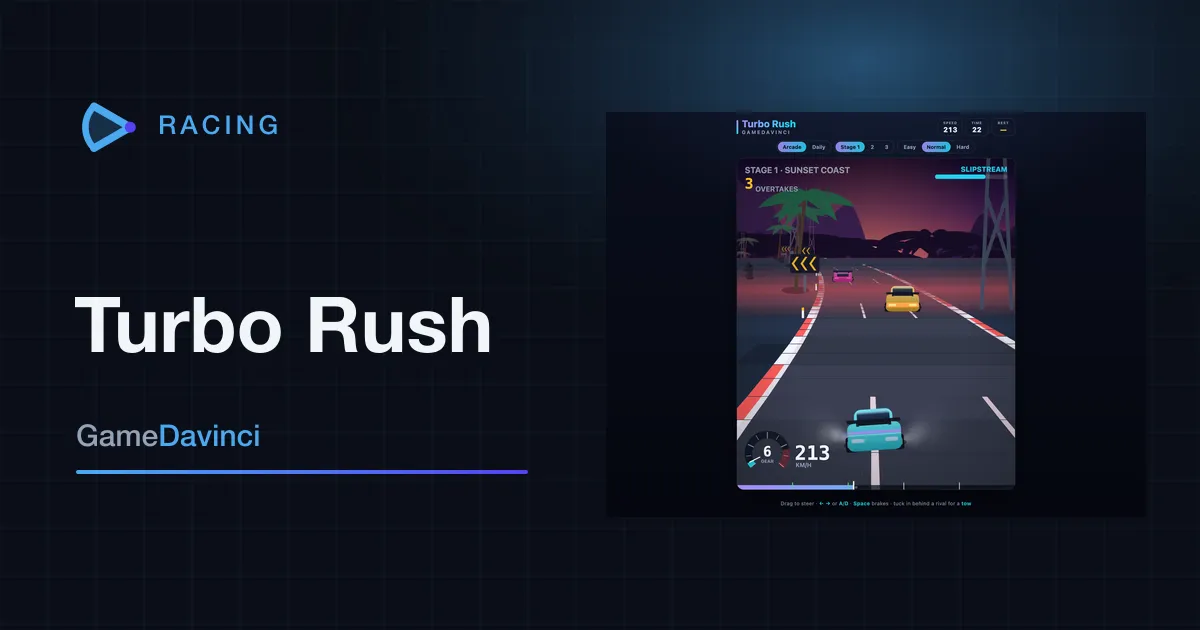
Turbo Rush
Throw a six-speed car down a pseudo-3D highway of banked corners and blind crests, slipstream past the field, clip every gate for more clock, and chase your ghost in the daily trial.
Racing -
 Featured
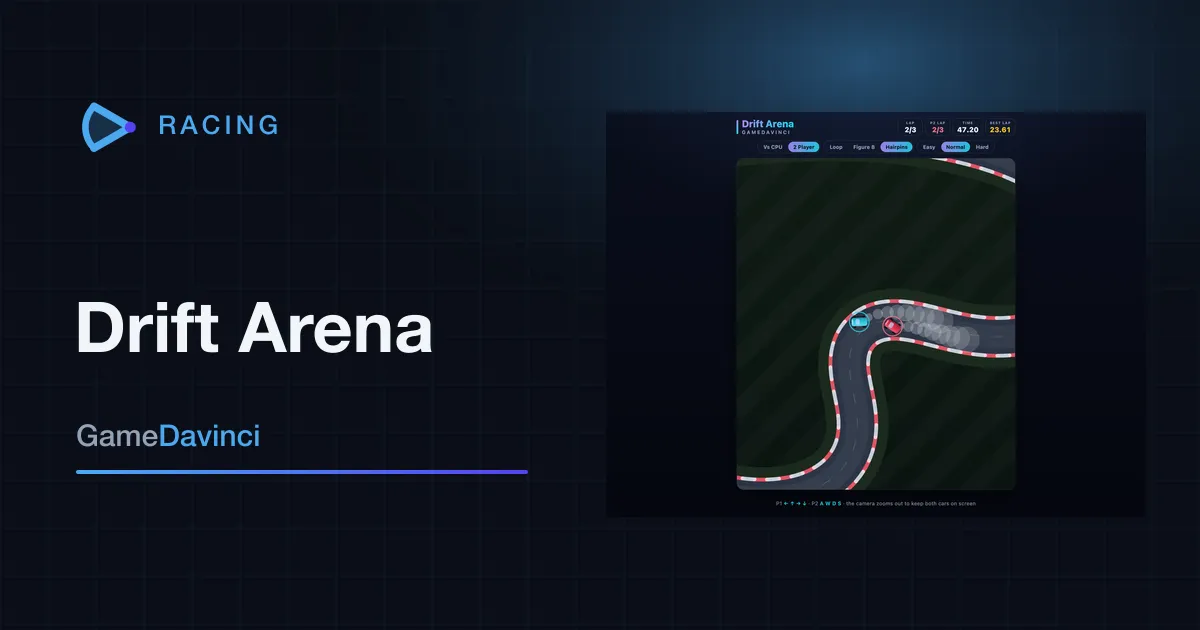
Drift Arena
Throw a top-down racer sideways through three circuits of tightening corners, catch the slide on the way out, and settle it over three laps against the computer or a friend on the same keyboard.
Racing -
 Featured
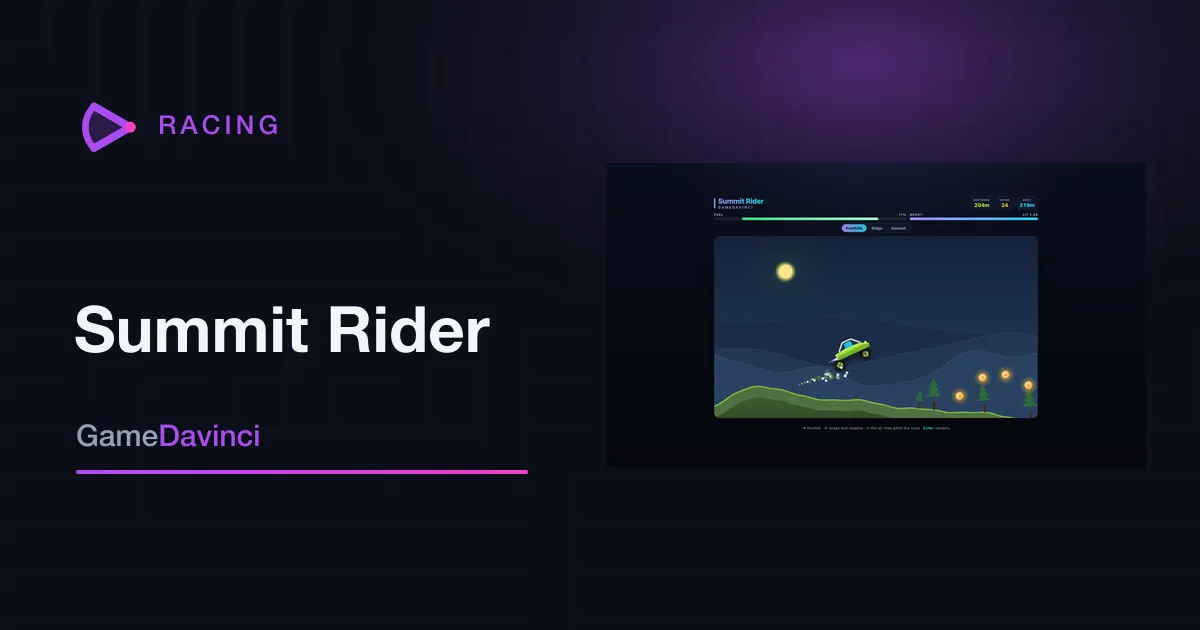
Summit Rider
Uphill physics driving over hills that are generated fresh every run: work the throttle so the nose stays down, set your attitude in the air, and go as far as the tank lets you.
Racing