How to play Word Ladder
Climb from one word to another by changing a single letter at a time. Every rung is a real word, and the game shows you the shortest ladder that exists.
Word Ladder is played between two words of the same length, called the start and the goal. A move replaces exactly one letter of the word you are standing on, and the result must be another word from the game's list. The ladder is the sequence of words you stand on, and the game is over when you are standing on the goal.
The exact move
One letter changes and the rest stay where they are. This is stricter than it sounds, and it is where new players lose steps.
Letters may not be reordered: CARE to RACE is not a move, even though both are words and they share every letter. Letters may not be inserted or removed: CAR to CART is not a move. And a letter that changes must land somewhere real — CAT to CAB is a move, CAT to CAX is not, because CAX is not a word.
A word that is already on your ladder cannot be played again. This costs you nothing, because revisiting a word can only lengthen a ladder, and it stops a run drifting in circles.
The word list
The game plays over one hand-picked list of common three- and four-letter English words, and that list is used for absolutely everything: what your typing is checked against, what the neighbour graph is built from, and what the shortest-ladder search is allowed to walk through.
This matters more than it looks. A game whose solver knows words its input rejects will tell you the shortest ladder is five when the shortest ladder you are permitted to play is seven, and you will spend the whole puzzle being told you are behind while playing perfectly. Because there is one list, the ladder par was measured on is always a ladder you can actually type.
Obscure words are deliberately absent. The list is smaller than a dictionary and every word on it is one an ordinary reader would recognise.
Par
Par is the number of rungs in the shortest ladder that exists between the start and the goal. It is worked out when the puzzle is dealt, by searching outward from the start word across every word one letter away, then every word one letter from those, and so on until the goal turns up. The depth at which it turns up is par.
Because the goal is chosen out of that search rather than picked first and checked afterwards, a puzzle that cannot be solved cannot be dealt. Solvable is not a property the generator tests for; it is a property of how the puzzle is built.
Par cannot be beaten. If you finish in fewer steps than par, the search was wrong.
Fewest
The third number on the board is the one to watch. Fewest is your steps so far plus the shortest ladder remaining from the word you are standing on to the goal, so it is the best total you can still finish on.
At the start it equals par. Play a word that moves you one rung closer and it does not move. Play a word that leaves you the same distance from the goal — a sideways step — and it rises by one. Play a word that moves you away and it rises by two, because you have spent a step and added one to the ladder ahead.
That is the whole feedback loop. You find out immediately, on the step, rather than at the end of the puzzle.
Levels
Ladders come in three and four letters, and each length has three levels. The level sets the range par is drawn from rather than any rule of play: a three-letter Easy ladder is three rungs, a four-letter Hard one is between seven and ten.
Longer is not simply harder. A long ladder gives you more chances to drift, but it also passes through more of the dictionary, so there are usually several shortest routes rather than one.
Dead ends
It is possible, playing carelessly, to reach a word whose every neighbour is already on your ladder. Nothing can be played from there. This is not a loss — Undo steps you back down the ladder, and Retry starts the same puzzle again from the start word — but it is worth recognising, because it usually means a run went a long way off the shortest route several steps earlier.
Finishing
Standing on the goal ends the ladder. The card reports your steps against par: reaching it in exactly par is a perfect ladder, and anything else is reported as the number of steps over. Your best result on a particular puzzle is remembered on your own device, so a ladder you finished in nine can be retried for seven.
Every puzzle carries a link that reproduces it exactly — the same start, the same goal, the same par — on anyone else's screen.
Controls
Type a word into the row under your ladder and press Enter to climb.
Keyboard
- Any letter types into the highlighted slot and moves along one.
- Enter plays the word in the row.
- Backspace puts back the letter that was underneath.
- Left and Right move the highlighted slot without changing anything.
Touch
- Tap a letter on the on-screen keyboard to type, and Enter to play the word.
- Tap any tile in your row to aim at that letter instead of retyping the whole word.
- Undo steps back down a rung, Hint offers a word on a shortest ladder, and Retry puts you back at the start word with the same puzzle.
Strategy tips
- Work backwards from the goal as well as forwards from the start. Most people only search one way, and the middle of a ladder is far easier to spot when you have two or three rungs already laid at each end.
- Watch Fewest, not Steps. Steps only tells you how long you have been going; Fewest tells you, on the move you just made, whether it cost you anything.
- Change the letter that is already wrong. If the goal is COLD and you are on CARD, the A and R are the problem — a step that alters the C or the D is almost always a step sideways.
- Vowels are the busiest letters in a short word. Swapping the vowel usually opens more onward moves than swapping a consonant, so a position that feels stuck often unsticks on the vowel.
- Endings are the cheapest bridges. Words sharing a final pair like -ALL, -INE or -OCK form dense clusters, and crossing between clusters is usually where a ladder's real work happens.
- If Fewest jumps by two, undo immediately. You have moved away from the goal, and one undo costs nothing while three more steps of improvising costs four.
- Retry a ladder you finished over par before taking a new one. You already know the hard part of the route, and closing a two-step gap is the fastest way to learn how the dictionary connects.
- Use a hint when you are genuinely stuck rather than restarting. It gives you a word from a shortest ladder, which teaches you the shape of the route instead of just moving you along it.
Now play Word Ladder
Free, in your browser, with no download and no sign-up.
Play Word Ladder →Word Ladder is a word game . See all word games or browse the whole catalogue .
More rules and guides
-
 Featured
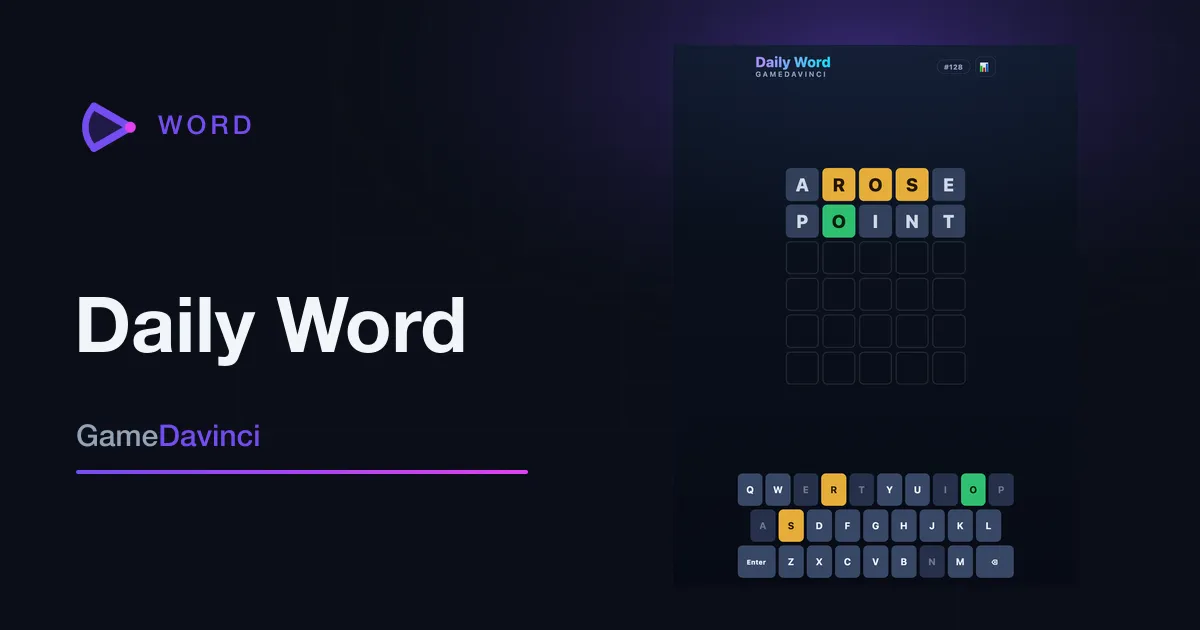
Daily Word
Guess the secret five-letter word in six tries. One fresh puzzle every day — come back to keep your streak alive.
Word -
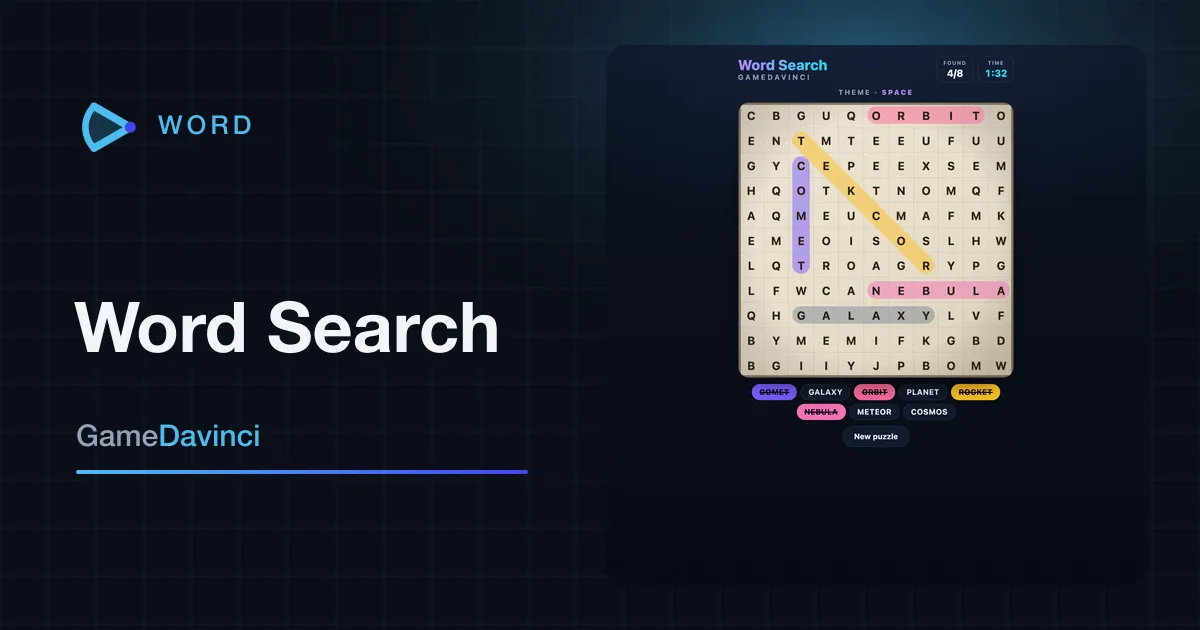
Word Search
Hunt hidden words in a letter grid — across, down, and diagonally, forwards or back — against the clock.
Word -
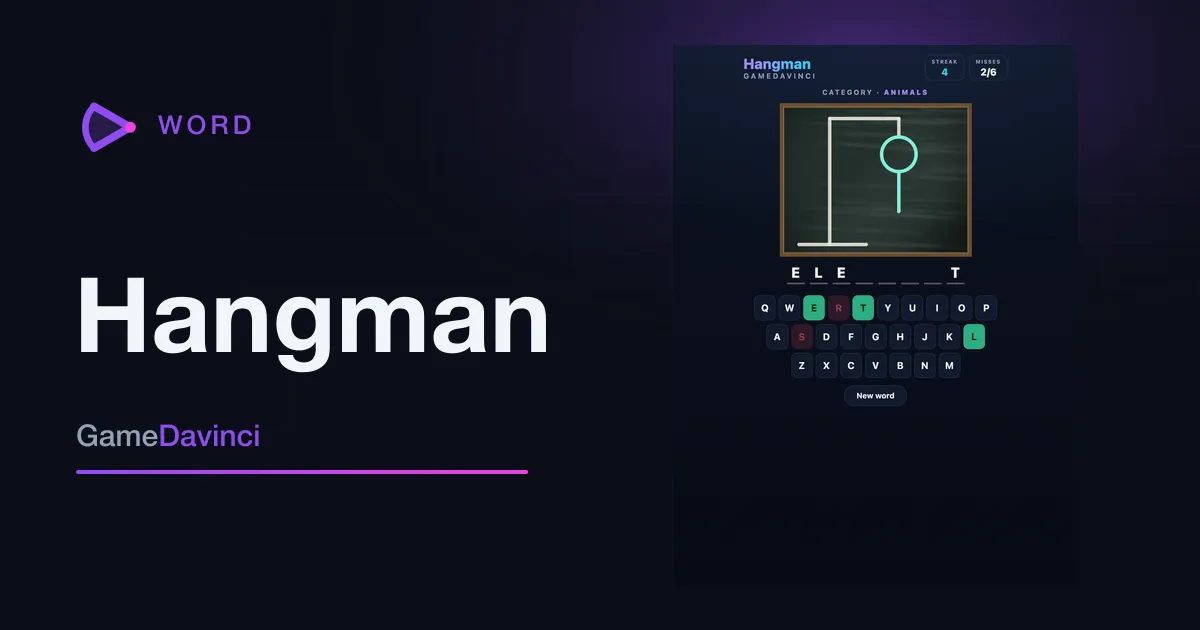
Hangman
Guess the hidden word one letter at a time — six wrong guesses and the round is over.
Word -
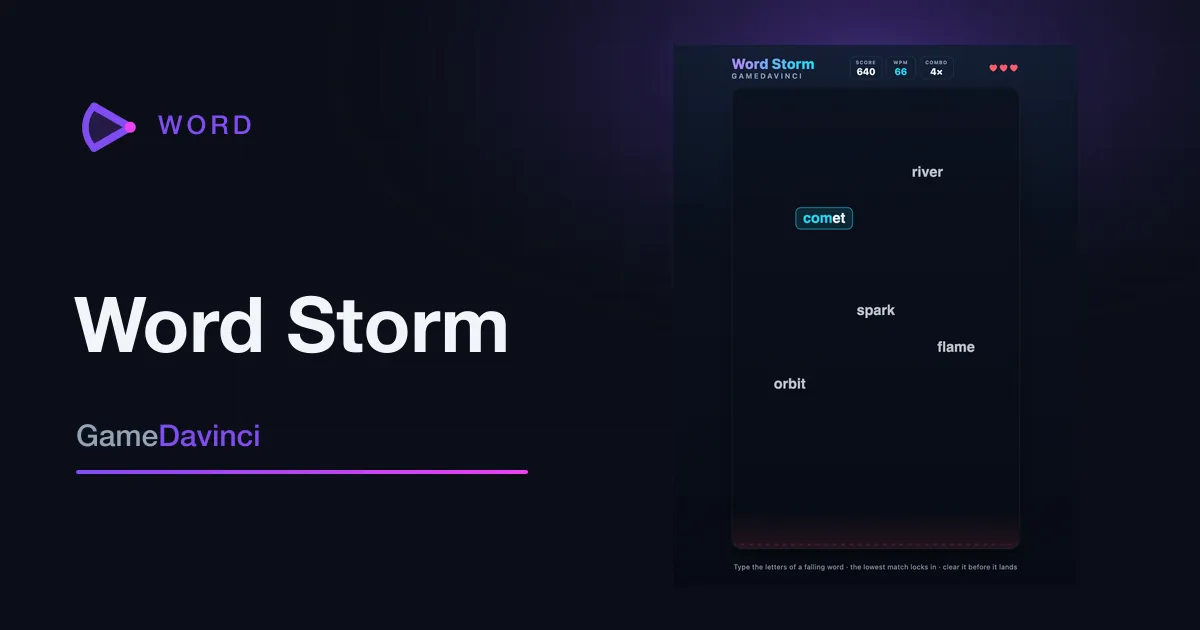
Word Storm
Type the falling words to blast them out of the sky before they land — a typing test disguised as an arcade game.
Word