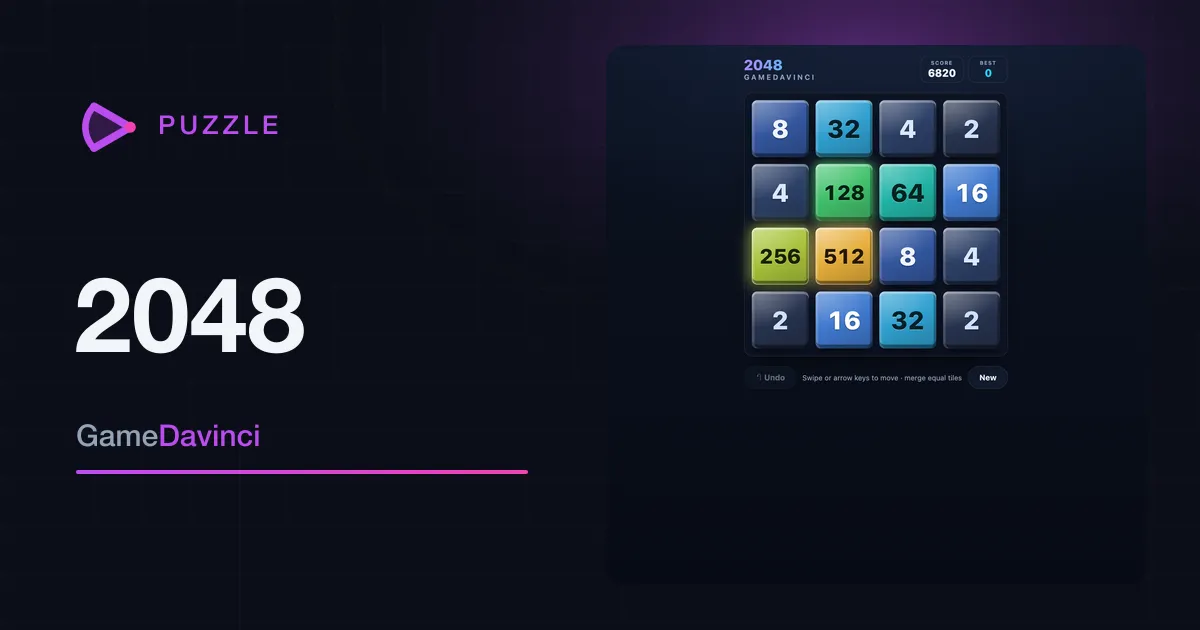

Search for how to win 2048 and every answer is the same: keep your biggest tile in a corner. It is good advice. We wanted to know how far it actually gets you, so we tested it on our 2048 by letting four different players loose on the same game, and counting how often each one made the 2048 tile.
The players were bots, because a bot does exactly what the strategy says and nothing else — which is what makes the result a test of the strategy rather than of the person.
The results
| Player | Games | Reached 2048 | Most common best tile |
|---|---|---|---|
| Random moves | 300 | 0 | 128 |
| Corner rule: down, then left, then right, up only when forced | 300 | 0 | 256 |
| Corner rule, choosing the move that leaves the most empty squares | 300 | 0 | 256 (512 in 38 games) |
| Looks two moves ahead, scores the board for order and space | 200 | 141 (70.5%) | 2048 |
The corner rule, on its own, never reached 2048 — not once in 900 games. Looking ahead reached it seven times in ten.
A note on fairness, because this is the kind of result that is easy to fake by accident. The look-ahead player plans with its own copy of the rules, so we checked that copy against the real game on 2,000 random boards before trusting it: every one matched. And every move all four players made went through the actual game, with its actual random tile spawns.
What the corner rule does
It helps. Random play topped out at 64 or 128 in 253 of 300 games; the corner rule most often reached 256, and more than doubled the typical score (a median of 2,408 against 1,116). Pinning the big tile stops you wasting it, which is the reason the advice exists.
But notice what the rule leaves out. It says where one tile goes and nothing at all about the other fifteen. Nothing in it stops a 2 landing between your 256 and your 128, or a row filling up with tiles that can never merge with their neighbours — and either of those ends a game just as surely as moving the big tile out of its corner.
What the look-ahead player does differently
It is not cleverer about the corner. It keeps the big tile there too. The difference is what it values in the rest of the board. Before every move it imagines each possible move, then each tile that could appear next, then its own best reply — and scores the resulting boards on three things:
- Order. Rows and columns that rise steadily toward the big tile. A board like 256-128-64-32 along the top edge is worth far more than the same tiles scattered.
- Space. Empty squares. Every empty square is a place the next tile can land without doing damage.
- Pairs. Equal tiles next to each other — merges waiting to happen.
That is the whole secret, and a person can do the same thing without any arithmetic: build a snake. Big tile in the corner, the next biggest beside it, then the next, running along the edge and folding back along the second row. Every merge should feed that line. Every move you make should keep it intact.
So, can you always win 2048?
No. Even the look-ahead player failed 59 games in 200; most of those ended one step short, with 1024 as the best tile. The tile that appears after each move is random, and sometimes it lands in the one square that breaks your line.
But a player who looks ahead can win most games, and the gap between "corner rule" and "winning" is not luck. It is looking one move further ahead than feels necessary and caring about the tiles you are not watching.
Three habits that follow from what the look-ahead player values:
- Keep the top row full. A gap in your snake's row is a square where a 2 can land inside the line, and a 2 there cannot merge with anything near it.
- Before you move, ask where the new tile can appear. If one of the squares it could land in would wreck your line, pick a different move.
- When you are forced into the forbidden direction, repair immediately. Sometimes no other move exists. The move after it matters more: put the big tile back before building anything else.
The rules — how merges resolve, when a move counts, how the spawn works — are on the 2048 rules page.
Play 2048 free — one thumb, no download, no account, and an undo for when the new tile lands in exactly the wrong place.
More games we have measured instead of guessing about: is Minesweeper luck? and what is a good Yatzy score?