
Ask ten Minesweeper players whether the game is luck and you get two answers. Beginners say yes, because they click and explode. Experienced players say no, it is pure logic — until the day they hit a board where two squares look exactly the same and one of them is a mine.
Both are partly right, and we wanted a number instead of an argument. So we wrote a solver for our Minesweeper that plays like a perfect, patient player: it only opens a square when it can prove the square is safe, using every number on the board and the count of mines left. When nothing can be proved, it has to guess — and we counted how often that happens.
The numbers
3,000 boards at each size, first click in the centre (our first click is always safe and always opens an area).
| Board | Finished with no guess at all | Won, guessing as well as possible |
|---|---|---|
| Easy — 9×9, 10 mines | 90.6% | 95.7% |
| Medium — 12×12, 26 mines | 54.7% | 79.9% |
| Hard — 16×16, 45 mines | 54.9% | 80.0% |
On an easy board, logic finishes the job nine times in ten. On the bigger boards, nearly half of all games reach a point where no amount of thinking can tell you which square is safe.
We checked the solver against itself while it ran: across all 9,000 boards it never called a square safe that turned out to be a mine, and never called a square a mine that was not. When it says "certain", it is.
Where the luck actually is
A forced guess is not a failure of skill. It is a position where two or more arrangements of mines fit every number on the board equally well, so the information you would need to decide is simply not there yet.
The most famous one is the 50/50: two unopened squares side by side, one mine between them, and nothing that touches either square differently. On easy boards the first forced guess was, in the typical case, exactly that — a coin flip. On medium and hard boards the typical first forced guess was kinder: the safest square available carried about a one-in-four or one-in-five chance of a mine. Forced does not mean fifty-fifty — among the squares you cannot prove, some are much safer than others.
That is the part of the game where skill comes back in. Guessing is unavoidable; guessing badly is not.
Guessing well is worth a lot
Look at the gap between the two columns in the table. A player who could only finish boards by pure logic would win about 55% of medium and hard games. A player who guesses the least risky square when forced wins 80%.
That difference — a quarter of all games — is the value of guessing well. Three habits get you most of it:
- Guess early, not late. A forced guess costs the same whenever you take it, but a loss at the start costs you ten seconds and a loss at the end costs you ten minutes. If a region is going to need a guess, take it before you have invested in everything around it.
- Count before you guess. The mines-left counter is a real clue. Late in a board it can turn a "guess" into a certainty — our solver uses it on every move, and it is an easy step to forget.
- Prefer the square with the most information behind it. A square that would open a new area, or resolve a whole row if it is safe, is a better gamble than one tucked in a corner that tells you nothing either way.
The deduction patterns themselves — reading a 1-2-1, subtracting overlapping numbers — are on our Minesweeper rules and strategy page.
So, is Minesweeper luck?
On an easy board, rarely: fewer than one game in ten. On a big board, roughly one game in two needs luck at some point, and the games that need any need about two forced guesses on average (1.85 on medium, 1.82 on hard). Everything around those moments is logic. The game is not a lottery; it is a logic puzzle with the occasional coin toss built in.
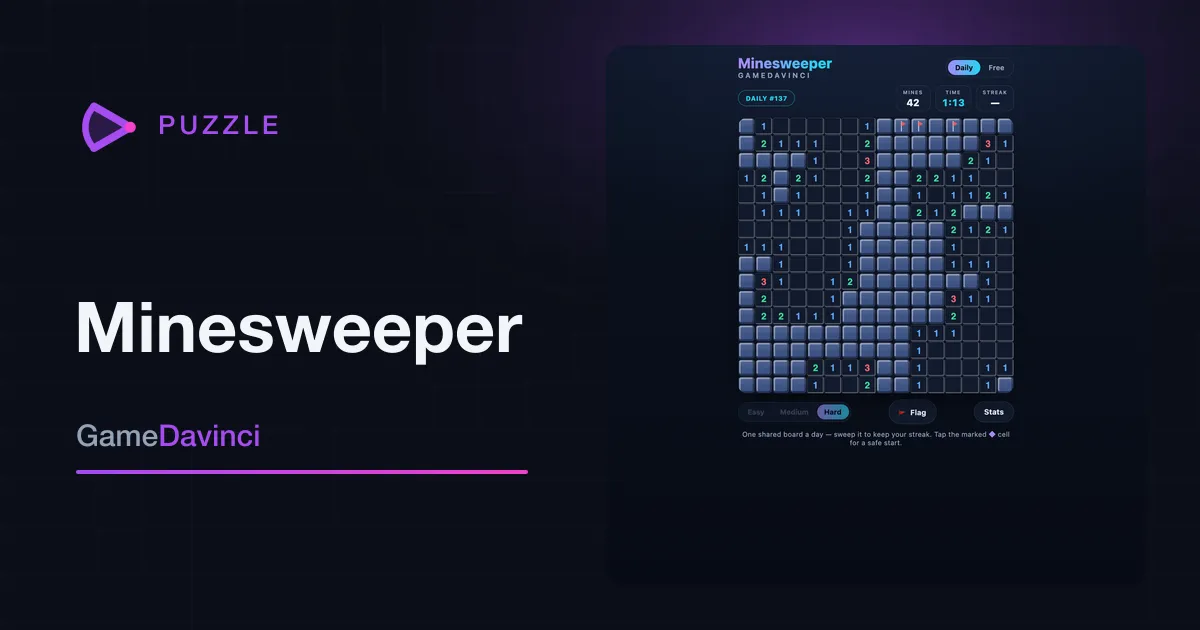
Which is why the daily board is a fair contest. Everyone gets the same grid and the same marked starting square, so if there is a coin flip in it, everyone faces the same one.
Play Minesweeper free — no download, no account, three board sizes and a daily challenge.
If you like knowing what a game is really made of, we did the same for Mahjong Solitaire and Pyramid Solitaire.