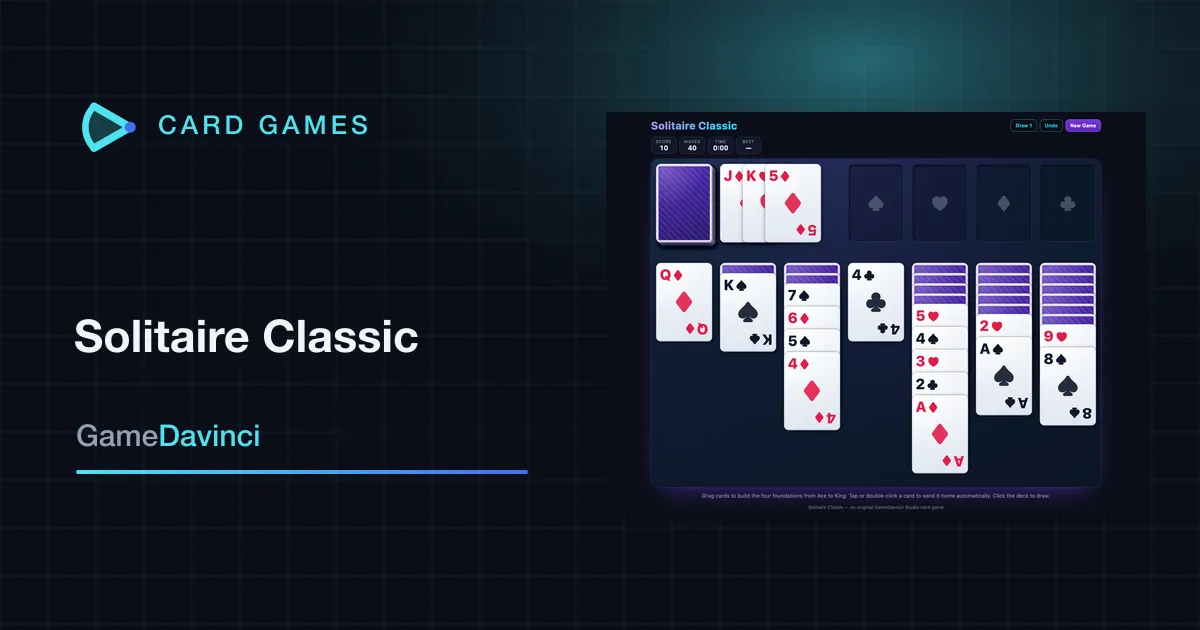

Most people who play solitaire have had the feeling: three passes through the deck, nothing moves, and the game is clearly over. Was that deal ever winnable, or did you lose it somewhere back on move twelve?
We wanted a real answer for our Klondike Solitaire, so we measured it. We took 500 shuffled deals straight from the game and played each one twice, once on Draw 1 and once on Draw 3. Two different players took part.
- A solver that can see every card, including the face-down ones. It tries line after line until it finds a win, proves there is none, or hits a limit of one million positions for that deal.
- A simple player that plays like a careful beginner. It only looks at face-up cards, prefers moves that turn over a hidden card, and draws when it has nothing better to do. It never looks ahead and never uses undo.
Every winning line the solver found was replayed move by move through the game itself, and the game had to accept every move and end with all 52 cards home. All 814 wins passed.
Is every solitaire game winnable?
No, but far more are winnable than it feels like.
Draw 1, same 500 deals:
- Proven winnable: 423 deals (84.6%)
- Proven impossible, every line tried: 13 deals (2.6%)
- Undecided within a million positions: 64 deals (12.8%)
Draw 3:
- Proven winnable: 391 deals (78.2%)
- Proven impossible: 45 deals (9.0%)
- Undecided: 64 deals (12.8%)
So the honest answer is a range. With perfect play, between 84.6% and 97.4% of Draw 1 deals can be won, and between 78.2% and 91.0% of Draw 3 deals. A deal that nobody can win does exist, but on Draw 1 we could prove it for only about one deal in forty.
That fits published solver research. Others' work, not ours, puts the share of Draw 3 deals winnable with every card visible at roughly 82%.
"With every card visible" matters. The solver knows what is under every face-down card before it moves. You don't, so you will sometimes make a move that looks right and buries the card you needed. That is the gap between the two numbers below.
Solitaire win rate: what a simple player actually wins
The careful beginner played the same 500 deals:
- Draw 1: won 102 deals (20.4%)
- Draw 3: won 18 deals (3.6%)
Put that next to the solver. On Draw 1, the simple player won 102 of the 423 deals the solver proved winnable, about one in four. On Draw 3 it won 18 of 391, fewer than one in twenty.
Most of the games you lose were winnable. On Draw 1, at most 15.4% of deals can be lost no matter what, and the simple player lost 79.6% of them. The missing wins are not bad luck. They are moves the solver found and the beginner did not.
So when a game locks up, assume a win was there to be found. Undo back to the last real choice, often a column you picked to unstack or a card you sent home, and try the other line. Our game has unlimited undo for exactly this.
Draw 1 vs Draw 3 odds
Draw 3 makes the game harder in two very different ways, and they are not the same size.
For perfect play, the cost is small. Winnable deals fall from 84.6% to 78.2%. In 23 of the 500 deals the change flips a win into a proven loss: the cards you need sit in the wrong place in the three-card groups, and no order of play fixes it. No deal the solver won on Draw 3 was proved impossible on Draw 1, and none could be: anything you can do on Draw 3, you can also do on Draw 1.
For a player who doesn't plan, the cost is enormous. The simple player's win rate fell from 20.4% to 3.6%, more than five times lower on the same deals.
The reason is the stock. On Draw 1 you can reach every stock card on every pass, so taking the obvious move rarely closes anything off. On Draw 3 you see only every third card. Each card you play from the waste shifts the groups for the rest of the pass, so it changes which cards you can reach next time. A player who takes whatever is on top of the waste, as our simple player does, keeps reshuffling those groups by accident. The solver chooses when to take a card and when to leave it, and it hardly notices the difference.
So if you want to win more games, play Draw 1. If you want Draw 3 to stop feeling hopeless, the skill it asks for is knowing the stock: what is in it, and which cards a waste play will bring into reach. The rules and strategy page covers how a pass works and how to learn the stock.
One habit we tested
We ran the simple player twice with one difference. The eager version sent every card to its foundation the moment it could. The patient version held a card back unless it was safe to send home (both cards of the opposite colour one rank lower were already home, so no card could ever need it as a base) or sending it home turned a card over, and tried every other move first.
On Draw 1, patient won 102 of the 500 deals and eager won 89. On Draw 3 both won 18. The edge is modest. Rushing a low card home spends a card you may need later to hold another one.
So, should you keep playing that deal?
Probably yes. On Draw 1, fewer than one deal in six can be lost by anyone, and we could prove it for only 2.6%. Losing usually means the win was still there. On Draw 3 the deal is lost more often, but still less often than it feels, because most Draw 3 losses come from how the stock was played, not from the cards you were dealt.
Play Klondike Solitaire free: Draw 1 or Draw 3, unlimited undo, no download, no account.
If you like knowing the odds before you start, we measured the same thing for Pyramid Solitaire, where the number of passes through the deck is the big lever, and for Mahjong Solitaire, where every deal can be cleared.