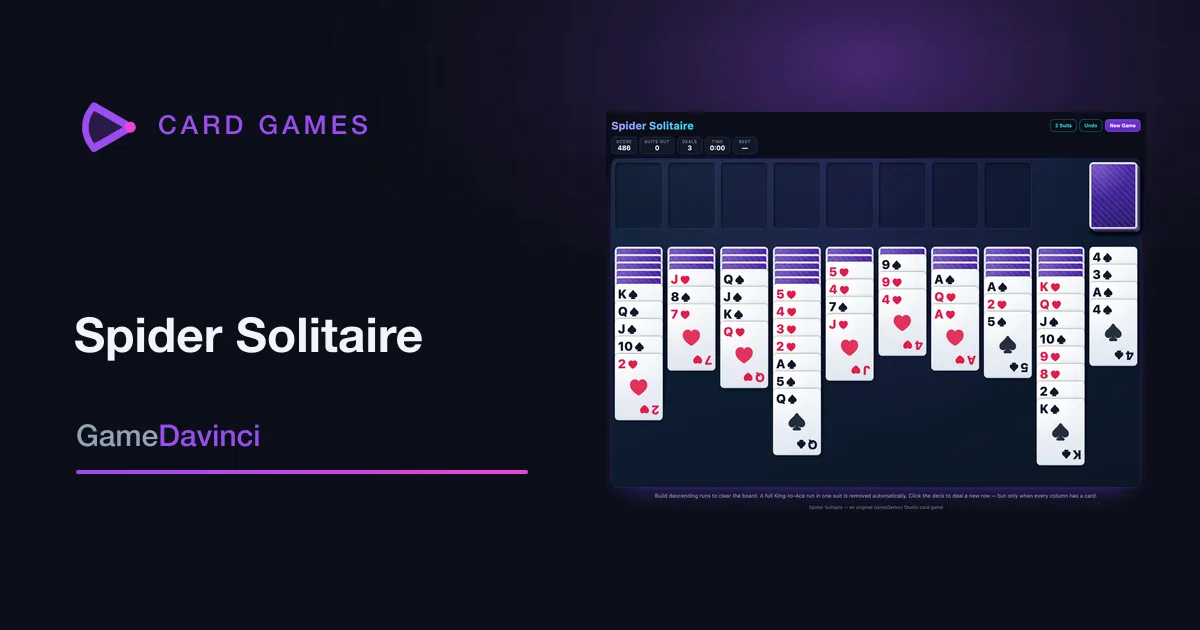

Spider Solitaire comes in three sizes: one suit, two suits and four. Everyone agrees four is harder. What nobody tells you is how much harder, because the usual comparison is unfair: you play a one-suit game on Monday, a four-suit game on Tuesday, and you are a different player with a different deal each time.
So we took the player and the deal out of it.
The test: same player, same deals, only the suits change
Our Spider Solitaire shuffles the two packs the same way at every suit count. Pick the same deal number in one-, two- and four-suit mode and every card lands in the same place with the same rank. Only the suit printed on it changes. We checked that on every deal rather than assuming it.
Then we wrote one bot and had it play deals 1 to 400 at all three suit counts: 1,200 games, played in the real game and checked by the game's own move rules. The bot plays like a careful player who never undoes anything:
- It sees only what you see. Face-down cards are unknown to it until a move turns them over.
- Each turn it looks through thousands of possible move sequences on the visible board and plays the one that most improves things: turning cards over, opening empty columns, building long same-suit runs.
- It deals a new row only when nothing on the board helps any more.
Every move it made was accepted as legal by the game, the board after each move matched what the bot expected, and a win was counted only when the game itself declared one.
The results
| Suits | Deals won, of 400 | Win rate | Average suits cleared per game |
|---|---|---|---|
| One suit | 342 | 85.5% | 7.29 of 8 |
| Two suits | 158 | 39.5% | 4.20 of 8 |
| Four suits | 9 | 2.3% | 0.46 of 8 |
Same 400 deals, same player. Going from one suit to two cost the bot more than half its wins. Going from two suits to four, its wins fell from 158 to 9.
The four-suit number is starker than the win rate shows. In 325 of the 400 four-suit games, the bot never completed a single suit. On one suit it cleared all eight in 342 games. The cards were in exactly the same places.
The wins mostly stack up the way you would expect. Of the 158 deals the bot won on two suits, 144 were deals it had also won on one suit. Of its nine four-suit wins, seven were deals it had also won on two. The exceptions are worth noticing too: 14 two-suit wins came on deals the bot had lost with one suit, which is a reminder that one game per deal is a noisy test of a single deal, even if the totals over 400 are solid.
Why suits matter so much
Spider lets you put any card on one a rank higher, whatever the suit, but you can only pick up a run as a group if it is all one suit. With one suit, every stack you build is a stack you can move later. With two suits, some of your stacks are knots. With four, most of them are, and the board fills up with cards you placed legally and can now only unpick one piece at a time.
That is what the cleared-suit counts show. The bot uses the same rules of thumb on four suits as on one. It is just that most of the moves it can find leave something stuck behind them.
Is Spider Solitaire always winnable?
We cannot answer that from this test, and it is worth being clear why. A bot's win rate is a floor, not the true share of winnable deals. When this bot loses, the deal may still have been winnable by a better player. What we can say is that at least 85.5% of one-suit deals, 39.5% of two-suit deals and 2.3% of four-suit deals in this sample can be won, because a player who sees no hidden cards and never undoes actually won them.
Two things make our bot weaker than you can be:
- It never undoes. Our game has unlimited undo. Undo lets you try a line, see what a face-down card turns out to be, and back out. The bot plays every game blind and in one take, so its numbers understate what a patient player with undo can win, especially on four suits.
- It looks a limited distance ahead. It searches up to 30,000 positions a turn and treats every face-down card as a mystery. A stronger search would win more.
So read the table as "how much harder each step is for the same player", not "how often a deal can be won". The ratios are the useful part.
What to do with these numbers
Treat two suits as a new game, not a harder level. On one suit our bot won almost six games in seven. If you are winning most of your one-suit games, expect to lose more than you win when you step up. That is the deal, not you.
Measure four-suit progress in suits, not wins. A bot playing without undo won nine games in 400 and failed to clear even one suit in four games of every five. If you finish a four-suit game with two or three suits cleared, you did better than this bot usually does. Count that as progress.
On four suits, undo is part of the game. Every advantage you have over our bot comes from looking before you commit. Undo in our game is free: it even hands back the point the move cost. Use it to test lines, not just to fix mistakes.
A lost one-suit game is rarely a near miss. The bot's 58 one-suit losses ended with about three suits cleared on average, and not one of them ended with seven. If one suit keeps beating you, look at the whole game rather than the last few moves: the strategy tips about empty columns and when to deal are the place to look.
Spider is the deep end of solitaire, and now you know how deep each end is. Play Spider Solitaire free in one, two or four suits, in the browser, no download.
If you like knowing the odds before you start, we did the same for Pyramid Solitaire, where the number of passes through the deck matters more than skill. For a solitaire where almost nothing is hidden, try FreeCell.