How to play Ninefold
Drag three blocks at a time onto a nine-by-nine grid. Fill a row, a column or a square and it clears. Keep going as long as you can.
Ninefold has three rules and one tension that grows out of them. The rules take ten seconds to learn; the tension is the game.
The rules
Three shapes are offered at a time in the tray. Drag one onto the grid anywhere it fits. Shapes never rotate and never fall — where you put it is where it stays.
When every square of a row, a column, or one of the nine three-by-three boxes is filled, that group clears. A single placement can complete several groups at once, and a square belonging to two completed groups clears once, not twice.
When all three shapes are gone, three more arrive. The run ends when nothing in the tray can be placed anywhere.
The tension
Filling the board and clearing the board are the same action. There is no way to pass, no way to discard, and no way to shrink a shape you did not want. Every placement is progress toward a clear and progress toward suffocation at the same time.
This is why the game is not really about the shape in your hand. It is about the shape of the space you leave behind. A placement that fits perfectly but leaves a one-square notch in the middle of the board has cost you far more than the two points it scored, because almost nothing in the bag is one square wide.
What the bag guarantees
Every hand of three is checked before it is offered: there is always some order in which all three can be placed on the board as it stands. This matters more than it sounds. A bag that does not check will, measurably, end roughly one run in sixteen the instant it deals — three shapes, nowhere for any of them, no move ever offered. That is indistinguishable from the game cheating.
So when a run ends here, it ends because the board had closed up before the hand arrived. The hand was playable when it was dealt; what you did with the first piece is what took the other two away.
When the board gets crowded the bag also stops offering the largest shapes. That is deliberate relief, not difficulty scaling — a three-by-three block onto a board with no three-by-three hole is not a challenge, it is a formality.
Scoring
A placement scores one point per square. A clear scores far more, and multiple groups cleared by one placement scale up sharply: two at once is worth three times one, three at once is worth six times. Clearing on consecutive placements builds a streak, and the streak multiplies every clear that follows it.
The consequence is that patient play beats greedy play. Taking a single line now often costs the double you could have taken next turn, and breaking a streak to take a small clear is usually the worse trade. The highest scores come from boards that look alarmingly full right up until they empty in one move.
Reading the board
Three habits separate long runs from short ones.
**Keep one region open.** A board with its space spread thinly in single squares is dead even when it is only half full. A board with a clear three-by-three hole can take anything.
**Watch the dimmed shapes.** A tray piece with nowhere to go is greyed out. That is not decoration — it is the board telling you it has closed a door, usually several turns before the run actually ends.
**Finish boxes, not just rows.** The nine three-by-three boxes are the easiest groups to complete by accident and the easiest to forget. A placement that completes a box and a row together is worth three times either alone.
The daily run
Every day seeds a fresh run. Because the bag reacts to your board, two players who place differently will diverge — the seed fixes where the run begins, not every shape you will ever see. Finishing extends your streak, and the share text carries your score and squares cleared without giving anything away.
Controls
Drag a shape from the tray onto the grid and let go to place it.
- The shape lifts above your finger while you drag so you can see the squares underneath.
- A preview shows exactly where it will land and which lines it would clear.
Strategy tips
- Leave one big hole open. Space spread thinly across the board is worthless — a single three-by-three gap is worth more than nine scattered ones.
- Never leave a one-square notch you cannot fill. Almost nothing in the bag is one square wide, so those gaps are usually permanent.
- Place the biggest shape in your hand first. It has the fewest homes, and deciding it last is how you end up with nowhere to put it.
- Finish the three-by-three boxes. They are the easiest groups to complete without noticing and the easiest to forget you are close to.
- A double clear is worth three singles, so hold a line open for one more turn when you can afford to.
- Protect your streak. Breaking a run of consecutive clears to take one small line is usually the worse trade.
- Watch for dimmed pieces in the tray. That is the board warning you it has closed up, several turns before the run ends.
- Work from the edges inward. Long straight shapes need a clear run of squares, and the middle of the board is where those disappear first.
Now play Ninefold
Free, in your browser, with no download and no sign-up.
Play Ninefold →Ninefold is a puzzle game . See all puzzle games or browse the whole catalogue .
More rules and guides
-
 Featured
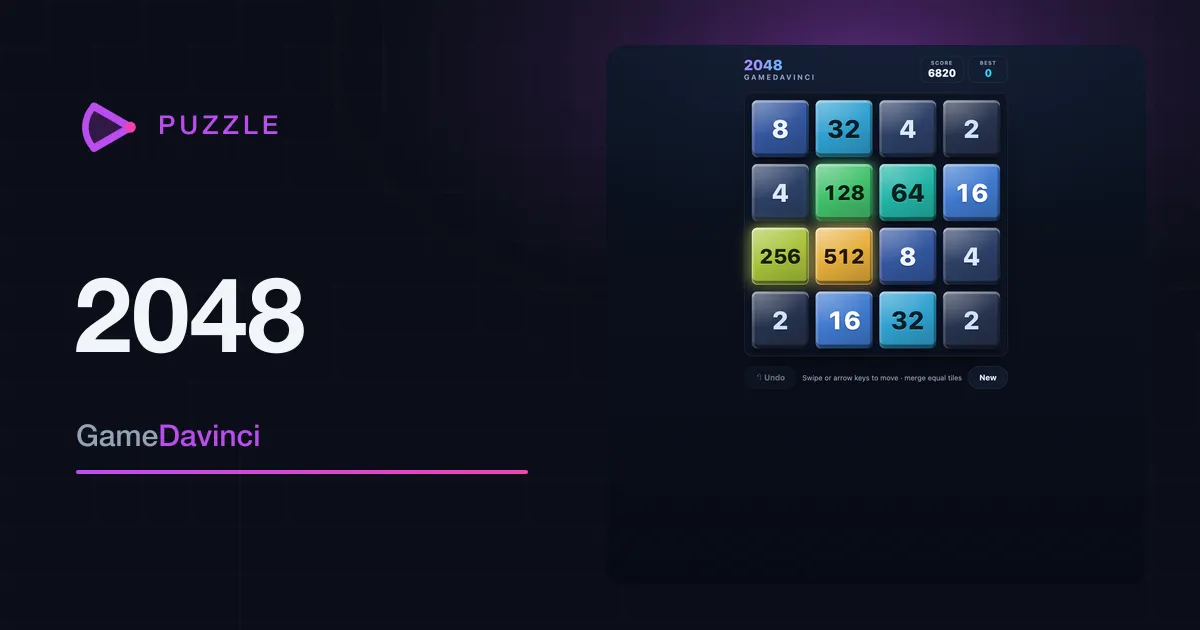
2048
Slide the numbered tiles, merge matching pairs, and chase the elusive 2048 tile — one more move never hurts.
Puzzle -

Gem Match
Swap two touching gems to line up three or more, then watch the chain reactions cascade for bigger scores.
Puzzle -
 Featured
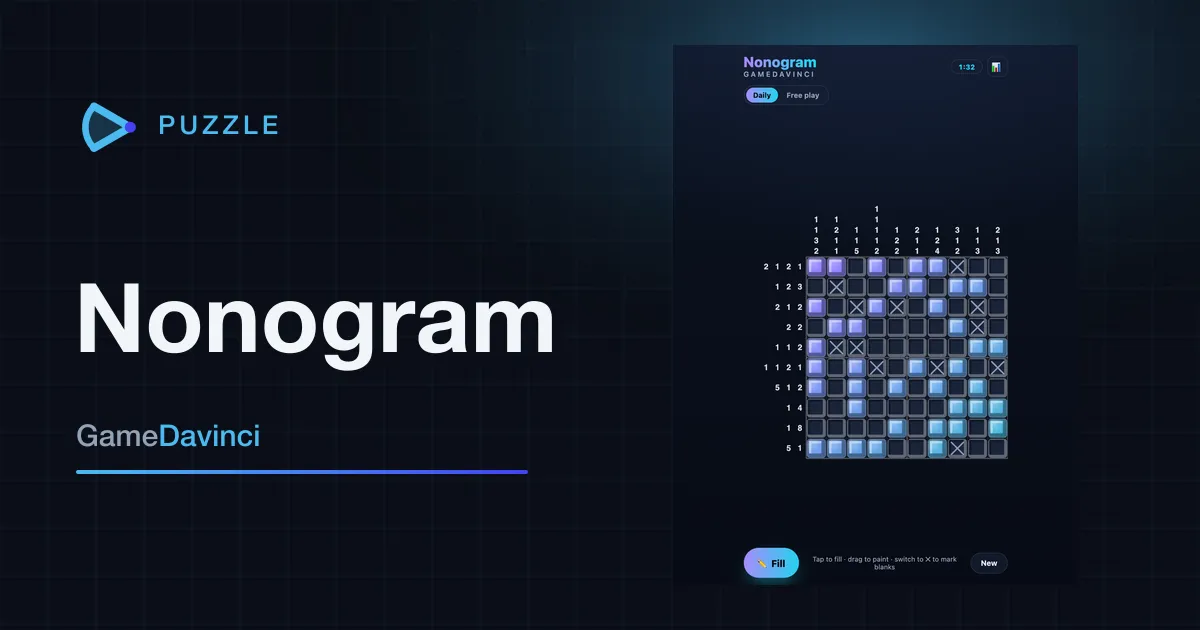
Nonogram
Use the number clues to figure out which squares to fill and reveal the hidden picture — one new puzzle daily.
Puzzle -
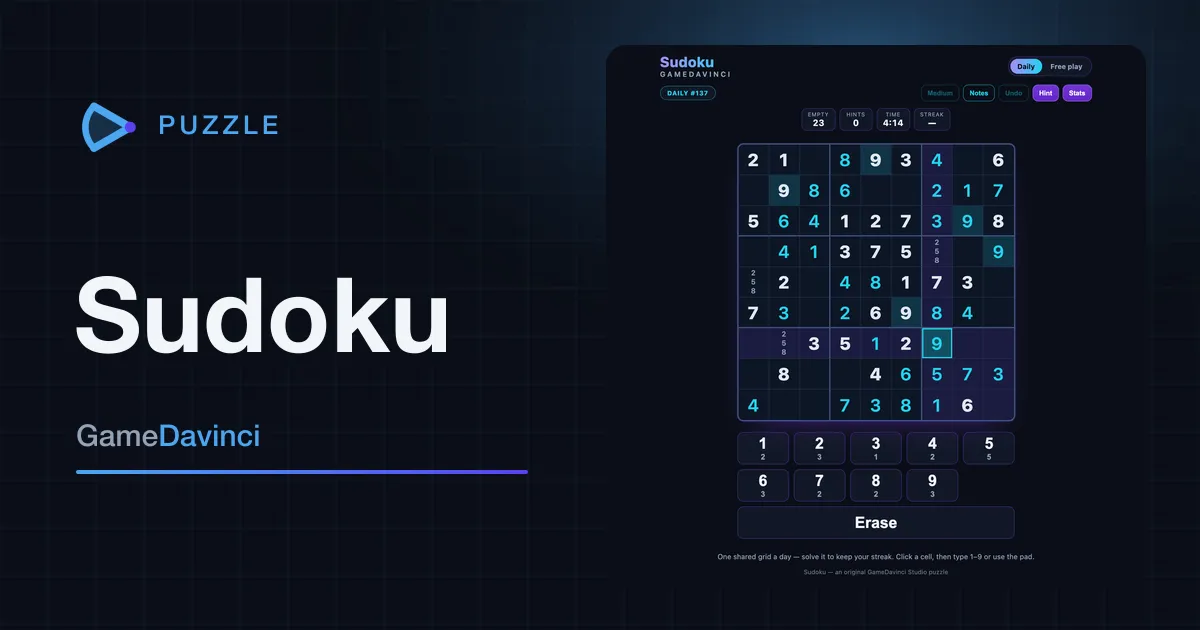
Sudoku
The classic number puzzle, now with a daily challenge — fill the grid so every row, column and box holds one to nine.
Puzzle