How to play Nonogram
Use the number clues to figure out which squares to fill and reveal the hidden picture — one new puzzle daily.
Nonogram — also sold as Picross, Griddlers and Hanjie — is a picture logic puzzle solved with numbers alone. Fill the right squares and a picture appears; the picture is the reward rather than the clue.
Reading a clue
Every row and every column carries a list of numbers. Those numbers are the lengths of the filled runs in that line, in the order they appear, and there is at least one blank square between consecutive runs.
So a row of ten squares clued 4 2 contains a block of four filled squares, then at least one blank, then a block of two, with any number of blanks before, between and after.
The order matters and the gaps matter. A clue of 4 2 is not the same as 2 4.
Marking blanks
Mark squares you have proved are empty with an X.
This is not optional bookkeeping. Nonograms are solved by finding what cannot be filled at least as often as by finding what must be, and an unmarked blank looks identical to a square you have not thought about yet. Solvers who skip the Xs stall on puzzles they could have finished.
The technique that unlocks the rest: overlap
The first move on almost every puzzle is overlap.
Take a line of ten squares with a single clue of 8. Push the run as far left as it goes and it covers squares 1 to 8. Push it as far right as it goes and it covers squares 3 to 10. Squares 3 to 8 are covered both ways, so they are filled no matter where the run actually sits.
That reasoning works on any clue large relative to its line, and it works with multiple clues too — pack them all left, pack them all right, and any square filled in both packings is certain.
Overlap is where you start on a blank grid, and it is usually enough to break a puzzle open.
The other everyday techniques
Edge forcing: if the first square of a line is filled, then the first clue starts there, so the whole run is determined and the square after it is blank.
Completion: once a line's total of filled squares matches the sum of its clues, every remaining square in the line is blank and can be crossed off at once.
Splitting: an X in the middle of a line divides it into independent segments. A clue of 5 cannot fit in a segment of four, which often eliminates possibilities immediately.
Cross-referencing: a square proved filled by its row constrains its column, and vice versa. Most of the middle of a solve is bouncing between the two.
No guessing
Every puzzle here is generated with a single solution reachable by logic. If you are stuck, something on the board is deducible — usually in a line you have not re-read since the last few squares changed.
The nonogram modes in full
The Daily puzzle is the same for everybody and builds a streak. Free play gives unlimited puzzles at five, ten or fifteen squares across.
Controls
Tap a square to fill it; drag to paint several in a row or column.
- Switch the tool to X (or right-click) to mark squares you've ruled out as blank.
- Row clues are on the left, column clues on top.
Strategy tips
- Start with overlap. Push a clue as far left as it goes, then as far right, and any square covered both ways is filled — that is the opening move on nearly every puzzle.
- Mark blanks with an X every time you prove one. An unmarked empty square is indistinguishable from one you have not thought about, and that is what stalls solves.
- Work the biggest clues first. A clue close to the length of its line constrains the most and gives up the most squares to overlap.
- When a line's filled count matches the sum of its clues, cross off the whole rest of the line. It is free, it is instant, and people forget to check.
- Use Xs to split a line. A blank in the middle makes two shorter segments, and a run that cannot fit in a segment is ruled out of it entirely.
- Bounce between rows and columns constantly. Almost every deduction in the middle of a puzzle comes from a square that one line proved and the other line uses.
- Re-read a line whenever a square in it changes. Most "stuck" moments are a line that became solvable three moves ago.
- Never guess. Every puzzle has one logical solution, so a coin flip that happens to work has taught you nothing and one that does not will cost you the grid.
Now play Nonogram
Free, in your browser, with no download and no sign-up.
Play Nonogram →Nonogram is a puzzle game . See all puzzle games or browse the whole catalogue .
More rules and guides
-
 Featured
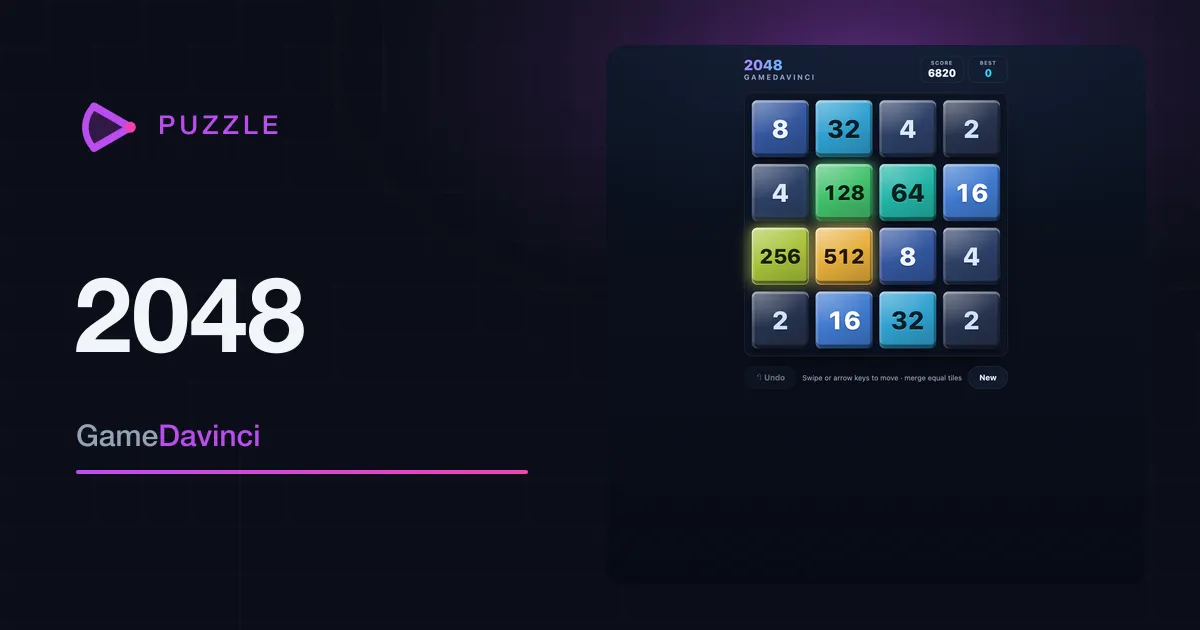
2048
Slide the numbered tiles, merge matching pairs, and chase the elusive 2048 tile — one more move never hurts.
Puzzle -

Gem Match
Swap two touching gems to line up three or more, then watch the chain reactions cascade for bigger scores.
Puzzle -
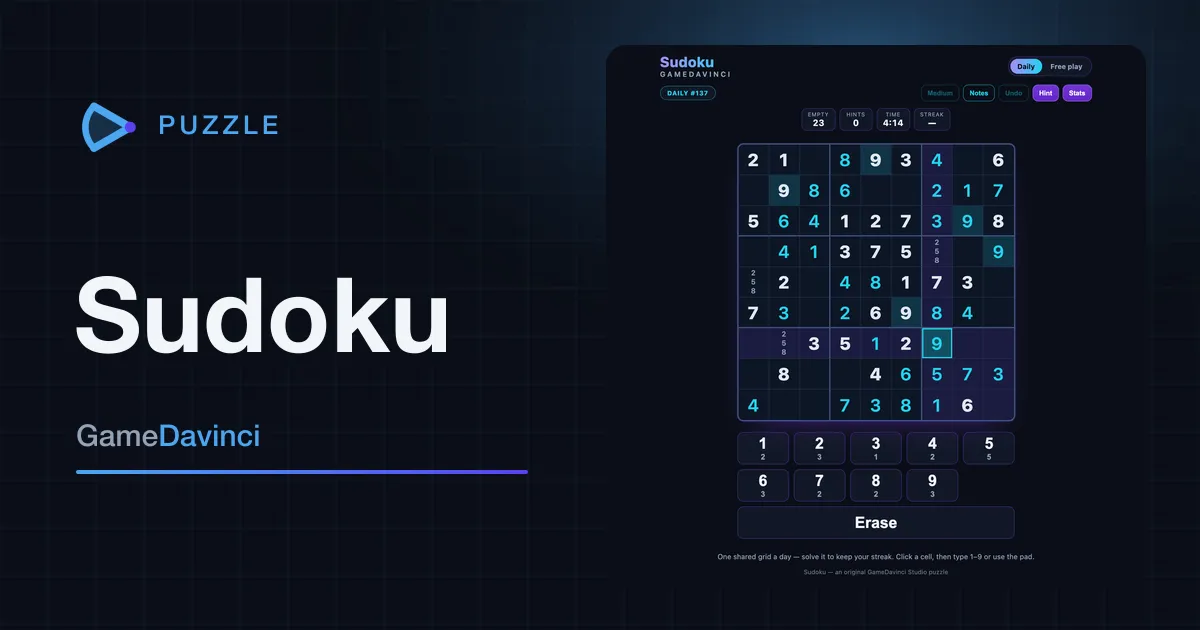
Sudoku
The classic number puzzle, now with a daily challenge — fill the grid so every row, column and box holds one to nine.
Puzzle -
 Featured
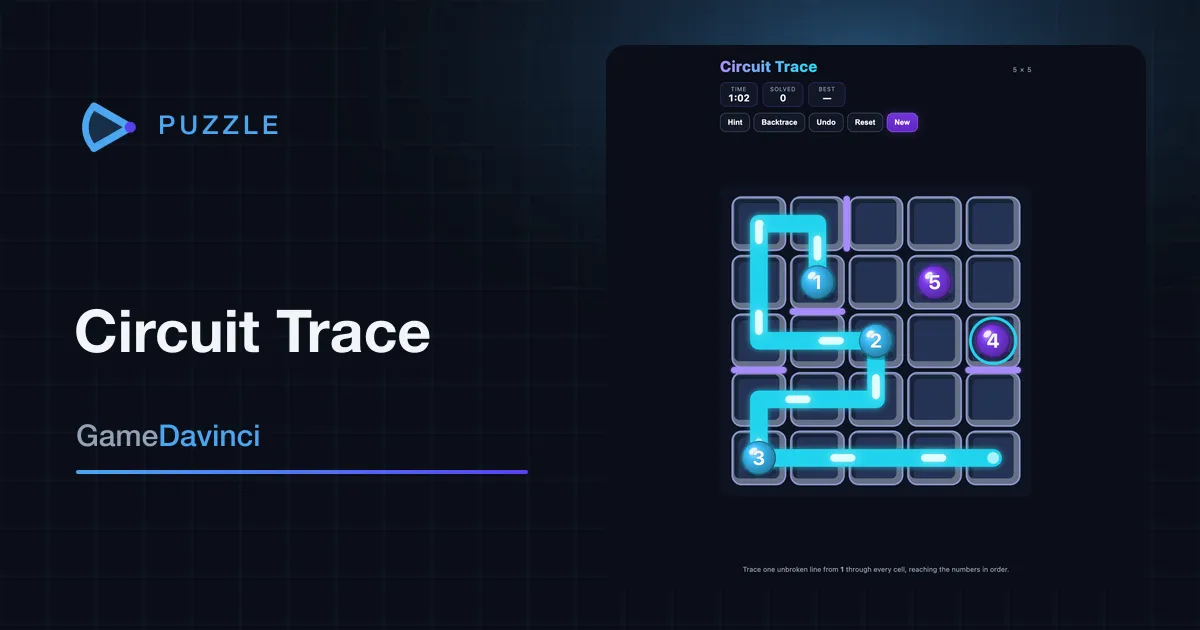
Circuit Trace
Draw one unbroken line that reaches every numbered node in order — and fills every last cell.
Puzzle