How to play Tile Order
Slide the numbered tiles back into order. On the small boards every route has been searched, so the number on screen is the true fewest moves — and matching it is a perfect run.
Tiles sit in a square frame with one square left empty. A tile next to the gap can slide into it. Nothing else is legal, nothing is ever added or removed, and the puzzle is finished when the tiles read in order with the gap in the bottom-right corner.
That is the whole game and it has been the whole game since the 1870s. What differs between versions of it is not the rules but whether the game can tell you anything about how well you played.
The number on screen
Most sliding puzzles count your moves and stop there, which tells you nothing: forty moves might be superb or might be twice what the board needed.
On the three-by-three and four-by-four boards this one searches the puzzle before you see it and shows the smallest number of moves that can possibly solve it. The word used is **Fewest**, and it is meant literally — the search is exhaustive in the sense that matters, so no shorter route exists. Finishing on that number is a perfect run and cannot be bettered.
On the five-by-five and six-by-six the same claim would be a lie. Proving a five-by-five optimal is out of reach of a browser and out of reach of most things that are not browsers. Those boards run the game's own solver instead and show what it managed, under the word **Par**. Par is beatable, and beating it is a genuine result rather than a rounding error.
The two are deliberately not called the same thing and do not look the same, because they are different claims. A proven minimum is marked in green; a par is not.
What proving it costs
The proof is affordable only because the boards are built to a known depth.
A fully shuffled four-by-four takes up to twenty-two seconds to prove optimal, which is not something to do while somebody waits. Built by a walk of forty-five moves, the same proof lands in nine milliseconds on a typical board and a fifth of a second on the worst one measured. So the walk is capped at forty-five, and that cap is what buys the number.
The honest consequence is that these four-by-fours are shorter than a completely random one: about thirty-four moves at the top of the ladder rather than the fifty-odd a free shuffle averages. That is the trade, and it is a trade — a shuffle nobody can measure would have been easier to ship.
The three-by-three has no such problem and runs to a full shuffle, where the hardest board possible needs thirty-one moves and a typical one twenty-two.
Every board can be solved
Half of all arrangements of a sliding puzzle cannot be solved at all, and a dead board looks exactly like a live one. You can lose an hour to a puzzle that never had an answer.
The usual fix is to shuffle freely and then repair the board using a parity rule. It works, but it means the same fact — whether this board can be finished — is written down in two places, and two places drift.
This game never shuffles. It starts from the finished board and walks the gap away from it, so every board it produces is solvable because a route home was just walked to build it. There is no parity rule in the game at all, because there is nothing for one to fix. The walk is also kept, and reversed it solves the board, which is where the target comes from on the boards that cannot be proved.
Pushing a run
Tapping a tile that is not next to the gap, but is somewhere along its row or column, slides every tile between the two at once.
This is not a shortcut so much as the thing that makes a six-by-six playable with a thumb. A six-by-six needs a few hundred moves and doing that one square at a time is not a puzzle, it is data entry.
The count still ticks once per tile, because that is the unit the target is measured in and a target measured in a different currency to your score is worthless. Undo, though, takes back the whole push, since that is the thing you actually did.
Reading a board
Two habits do most of the work.
The first is to solve the top row and the left column and then forget they exist. What is left is a smaller puzzle of exactly the same kind, and the whole method is to keep shrinking it until three squares by three remain, which can be finished by feel.
The second is to stop chasing the tile you want. Almost all of the work is moving the **gap** to where it needs to be, and the tile only travels on the one move in four or five where it is in the way. Players who think in terms of driving the gap around improve faster than players who think in terms of dragging tiles.
The corner of a row is the part worth learning properly. The last two tiles of any row cannot be placed one after the other — putting the last one home pushes the other one out. They go in together, by parking the second-to-last tile in the corner and the last one directly beneath it, then rotating both in with one turn.
The ladder
Boards run from three-by-three up to six-by-six, and the shuffle deepens as you clear levels.
It stops at six on purpose. A seven-by-seven takes around six hundred and forty moves and uses not one technique that a five-by-five does not, so it is longer rather than harder, and length is not difficulty.
The daily board
One four-by-four a day, the same for everybody, built from the date — the size that gets a proven minimum, so everyone is chasing the same real number.
Finishing extends your streak, your best move count is kept, and the share text carries your moves, that board's fewest and your time without giving the arrangement away.
Controls
Tap any tile in the same row or column as the empty square and everything between it and the gap slides at once.
Touch
- Tap a tile to slide it, or tap further down the row to push several.
- Swipe in any direction to slide the one tile next to the gap.
Keyboard
- Arrow keys or W, A, S, D slide one tile.
- Z undoes.
Strategy tips
- Drive the gap, not the tile. Nearly every move is about getting the empty square where it needs to be, and the tile you care about only moves on one turn in five.
- Solve the top row and left column first, then treat the rest as a smaller puzzle of the same kind. Keep shrinking it until only three by three is left.
- Learn the last two tiles of a row as one move, not two. Placing the final tile pushes the other one out, so they have to go in together with a rotation.
- Park the second-to-last tile of a row in the corner and the last one under it, then turn both in at once.
- Tap down the row rather than one square at a time. It costs the same in moves and saves you four taps out of five on the big boards.
- Undo freely on a proven board. It gives back the moves it took, so exploring a route costs nothing but the numbers you already spent.
- Do not chase the Fewest number on your first look at a board. Solve it once, see the target, then play the same size again knowing what is possible.
- On 5×5 and 6×6 the par is beatable, so treat it as a rival rather than a ceiling — the solver is good, not perfect.
Now play Tile Order
Free, in your browser, with no download and no sign-up.
Play Tile Order →Tile Order is a puzzle game . See all puzzle games or browse the whole catalogue .
More rules and guides
-
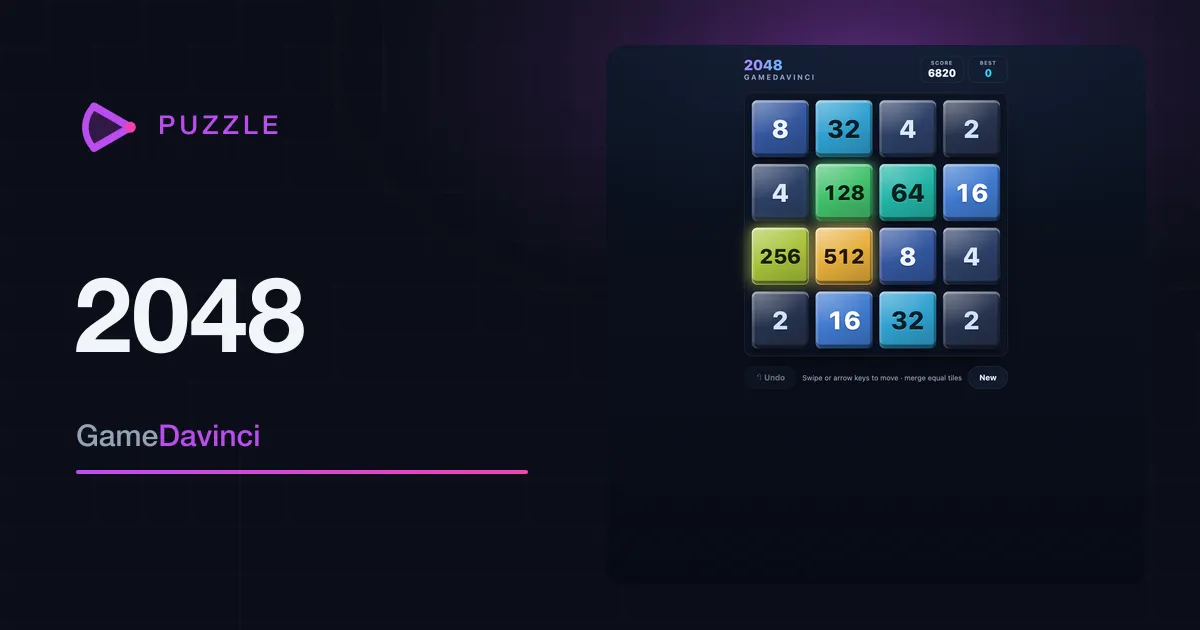 Featured
2048
Slide the numbered tiles, merge matching pairs, and chase the elusive 2048 tile — one more move never hurts.
Puzzle -

Gem Match
Swap two touching gems to line up three or more, then watch the chain reactions cascade for bigger scores.
Puzzle -
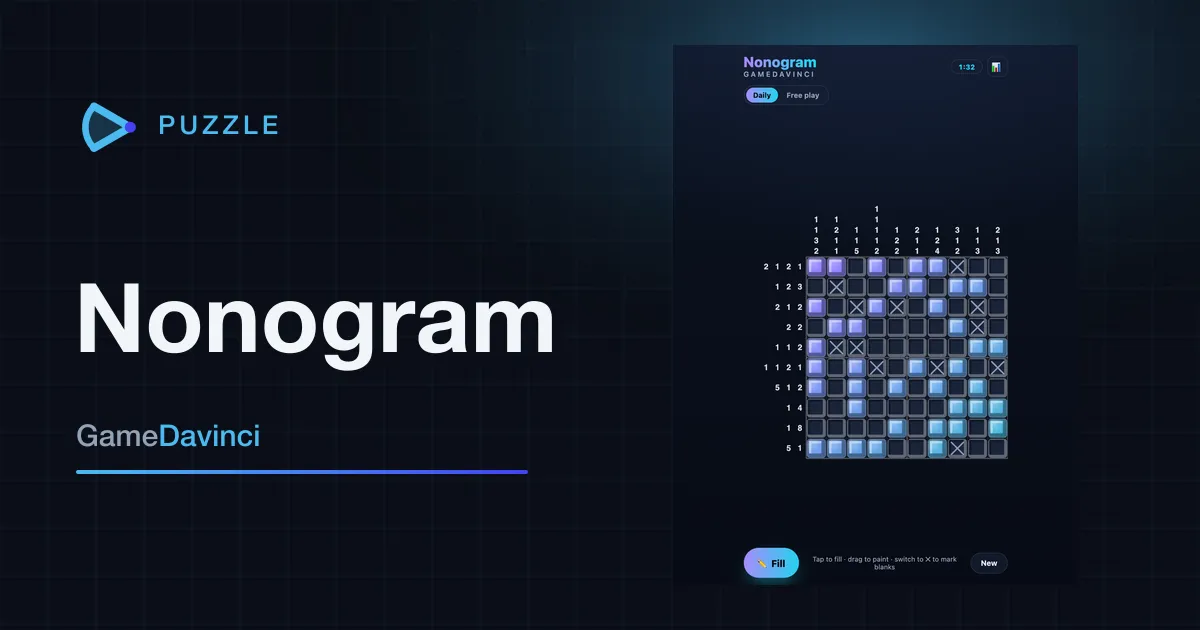 Featured
Nonogram
Use the number clues to figure out which squares to fill and reveal the hidden picture — one new puzzle daily.
Puzzle -

Sudoku
The classic number puzzle, now with a daily challenge — fill the grid so every row, column and box holds one to nine.
Puzzle