How to play Depot — Crate Puzzle
Push every crate onto a pad in a warehouse where nothing can be pulled back. Then build a depot of your own — it only publishes once a solver has proved it.
Depot is a sokoban — a crate-pushing puzzle — and everything difficult about it follows from one missing verb. There is no pull.
The floor
A level is a walled warehouse floor between seven and eleven squares across. On it are crates, an equal number of pads, and one loader, which is you. The loader walks freely through any empty square. When it steps into a crate, the crate slides one square in the same direction — provided the square beyond it is empty floor. A crate will not move into a wall, and it will not move into another crate, so crates can never be pushed two at a time. The level is solved the moment every crate stands on a pad.
Pushes and moves, and why only one of them counts
Two numbers run at the top of the screen. Moves counts every square the loader travels; pushes counts only the steps that actually shifted a crate. Par is measured in pushes, and that is not an arbitrary choice — walking is reversible and pushing is not, so the pushes are the decisions and the walking is just the cost of getting to them. Two solutions with the same pushes are the same solution as far as this game is concerned, which means you are free to wander while you think.
No pull, and what that costs
A crate pushed against a wall can never leave that wall except by sliding along it. A crate pushed into a corner is finished — it cannot go forwards, and nothing can drag it back. Two crates side by side against a wall are both finished, because neither can be pushed along and neither can be pushed away. These are the deadlocks, and a level is lost the instant one happens even though the board still looks playable.
Depot will not let that sit quietly. It knows which squares no crate can ever return from, and it knows the four-cell blocks that can never come apart, so the moment a crate becomes unrecoverable the game says so and points you at undo. The editor draws those doomed squares onto the floor while you build, which is the fastest way anyone has ever learned the shape of a trap.
Par is proven, not estimated
Every level ships with a par, and every par is re-proved on the device in front of you as the level loads. The search is a breadth-first walk over pushes rather than over steps, on a state made of the crate positions plus the region the loader can reach — because if the loader can walk from A to B without touching anything, standing at A and standing at B are the same position. Collapsing those is what makes an exact answer cheap enough to compute on a phone between two frames.
The first time that search reaches an arrangement with every crate home, the depth it reached is the minimum number of pushes that exists. So the par on screen is not a target somebody felt was fair: it is a proof that no shorter solution is possible. Beating par is not hard, it is impossible, and matching it means you found an optimal line.
The search is bounded on purpose, by a node cap and by a clock. When a level is too big for the budget the game says it could not verify the par rather than inventing one, because a bounded search that reports failure as impossibility is a bounded search that lies.
The campaign and the endless depots
Sixty levels come with the game, sorted into four bands by floor size. They open at four pushes, cross ten around level thirteen, and finish in the high twenties and low thirties. Your best push count is kept per level, and a level you matched par on is marked differently from one you merely cleared — the level grid shows both at a glance.
Past level sixty the game generates depots for you, forever. They are built backwards from the solved position: every crate starts on its pad and the generator repeatedly undoes a push, sliding a crate one square back while the loader stands behind it. Every one of those steps is the exact reverse of a legal push, so the finished level is solvable by construction and the solver is only ever asked how short the shortest solution is, never whether one exists.
The editor and the publish gate
Build hands you the same floor the campaign is made of. Five tools paint walls, crates, pads and the loader, and erase; the size button cycles the floor from seven squares to eleven. Test drops you straight into your level to play it.
Publish is the interesting one, because it is a gate rather than a save button. Before it will give you a link it checks the obvious things — there is a loader, there is at least one crate, the crates and pads are equal in number, no crate has been placed somewhere it can never leave, and the level is not already solved — and then it runs the same prover the campaign uses. Only a solved verdict produces a link, and the link carries the par the prover found. If the search drains without finding a solution the level is refused as impossible. If it runs out of budget instead, the answer is "could not verify", which is a different sentence for a different fact, and the level is still refused.
A published level is encoded into the link itself — three bits a square, base sixty-four — so there is no account, no server and no upload. The URL is the level. Anyone who opens it gets it re-proved on their own device before they play, and Build turns their copy into a starting point for something of their own.
Controls
Swipe or press an arrow key to push. The loader shoves crates forward and can never pull one back.
Touch
- Swipe in any direction to take one step, moving whatever is in front of you.
- Tap a clear square to walk there by the shortest route, or tap a crate you are lined up with to push it.
Keyboard
- Arrow keys or W A S D move the loader one square.
- Z undoes the last move and R resets the depot to its opening position.
Strategy tips
- Find the corners before you touch anything. Any crate that reaches one is lost, and on most levels two or three squares are the only real danger.
- Push a crate onto a wall only when you know which way it will travel along that wall, because once it is there it can only slide, never leave.
- Solve the crate that has to go furthest first, while the floor is still open. The last crate has the whole level to move through, so it is the cheapest one to leave until the end.
- Do not fill a pad that sits in a doorway too early. A crate parked on it is a wall for everything that still has to come through.
- Walking is free, so plan the whole approach before the first push. Getting to the far side of a crate can take fifteen steps and cost you nothing.
- Count pushes, not moves. A tidy-looking route that shoves a crate one square and then shoves it back has already cost you two.
- Undo the moment the game says a crate is stuck. It is telling you the level is unwinnable, not that it is getting harder.
- If you clear a level well over par, reset and run it again straight away. The second attempt on a floor you have already read is where par is normally found.
- In the editor, watch the marked squares as you paint. They show exactly where a crate could never come back from, which is the whole skill of building a fair level.
Now play Depot — Crate Puzzle
Free, in your browser, with no download and no sign-up.
Play Depot — Crate Puzzle →Depot — Crate Puzzle is a puzzle game . See all puzzle games or browse the whole catalogue .
More rules and guides
-
 Featured
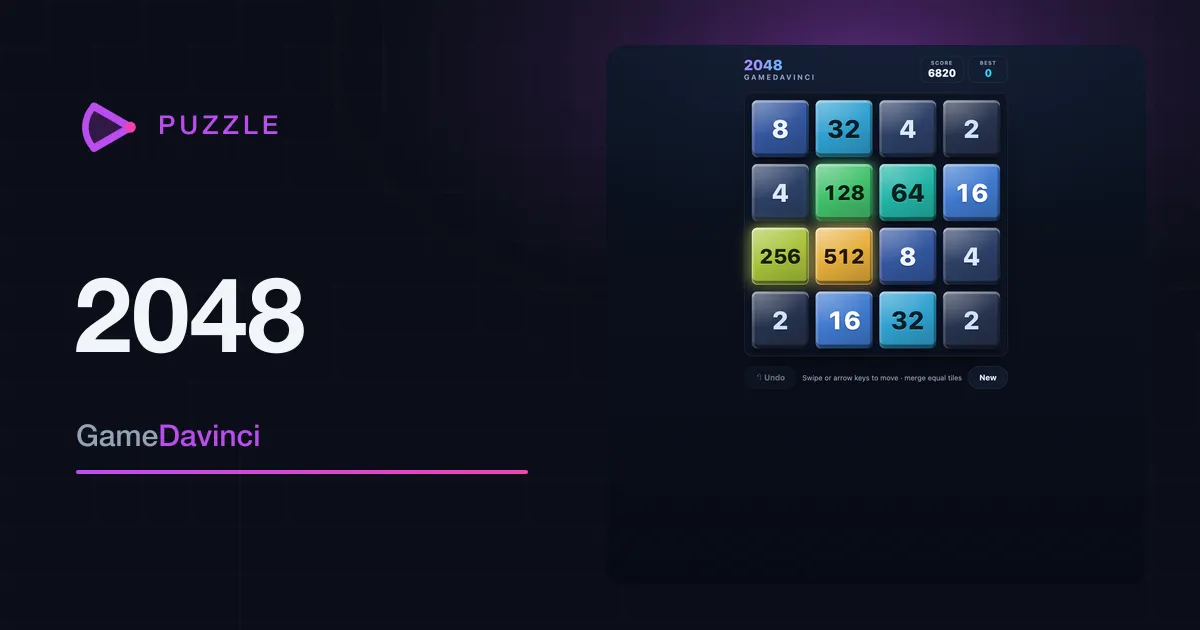
2048
Slide the numbered tiles, merge matching pairs, and chase the elusive 2048 tile — one more move never hurts.
Puzzle -

Gem Match
Swap two touching gems to line up three or more, then watch the chain reactions cascade for bigger scores.
Puzzle -
 Featured
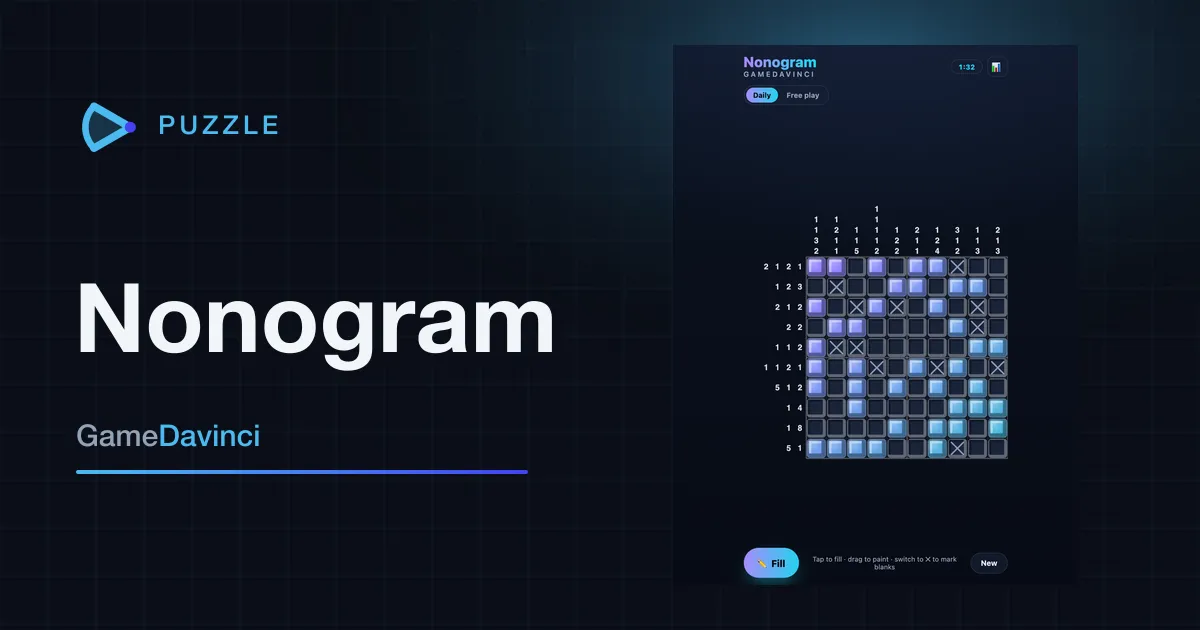
Nonogram
Use the number clues to figure out which squares to fill and reveal the hidden picture — one new puzzle daily.
Puzzle -
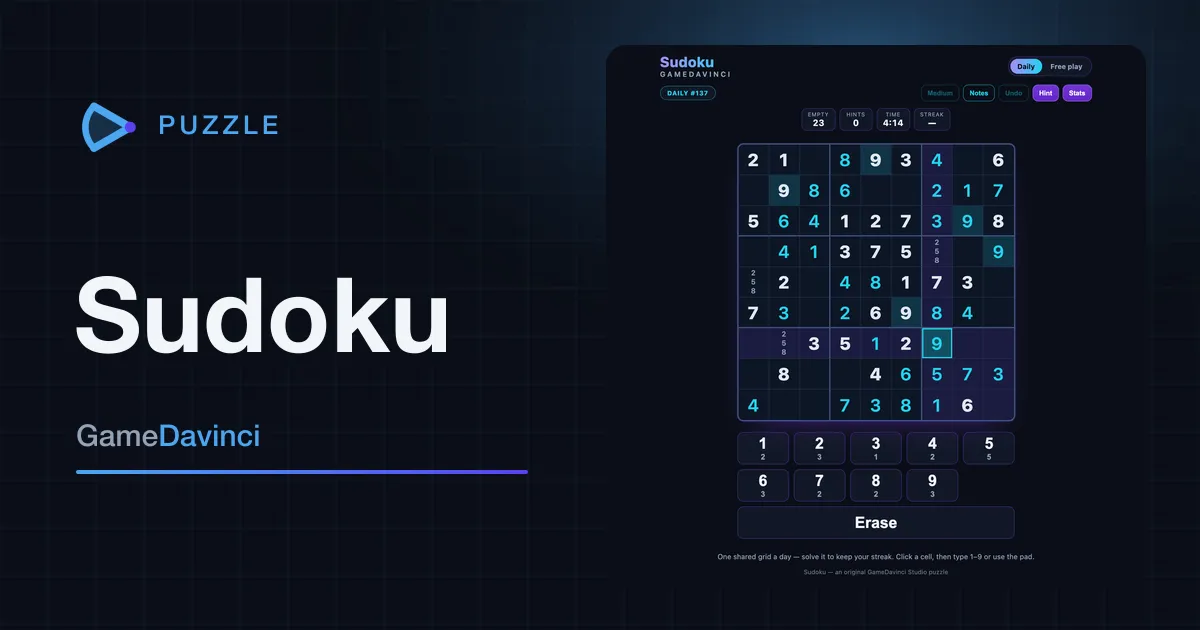
Sudoku
The classic number puzzle, now with a daily challenge — fill the grid so every row, column and box holds one to nine.
Puzzle